Category

Mental health

toddler crawling

Early movement

By children's health, dance & Art, Education, Exercise, fun for children, Mental health, Playing, Relationships, Sport, Theatre
by Alice Liley, TumbleTots Worthing

Movement is one of the many ways babies and young children start to understand the world around them. Think about a baby rolling all the way over for the first time, or a preschooler jumping around with excitement. These moments aren’t just cute, they’re important steps in your child’s development. As parents, we have the joy of cheering them on as they master the basics and gradually build skills like balance, climbing and agility. These skills don’t just help them stay healthy, they also help with thinking, learning, managing feelings and making friends.

It’s good to remember that every child moves in their own way and at their own pace. Some babies might crawl early, others might take their time. What matters most is giving them lots of relaxed and engaging chances to play and spaces to try new things, so they can build confidence and learn new skills whilst having fun with you.

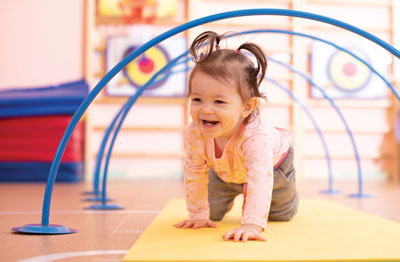
Agility might sound like a skill reserved for athletes, but in reality, it is simply about moving with control and adapting to new situations. Babies begin by crawling, then cruising and then walking. Children build their agility by learning to adapt their skills – crawling under tables, climbing over cushions and reacting to the space around them. Games like chase, dancing or dodging obstacles helps them to get better at moving as well as teaching them how to play with others as they grow.

Balance is fundamental to physical development. Babies start working on balance as soon as they learn to sit up and roll. As they grow, playing on uneven ground, stepping over toys or kicking a ball all help build their core muscles and balance. Letting your child play and move on their own, without holding their hand too tightly, helps them trust their bodies and become more independent in balance.

Climbing is another valuable way to develop strength and problem-solving skills. Whether your child is pulling up on the couch, climbing stairs or exploring a playground, they’re learning to plan their moves and judge distances. The goal isn’t always to climb the highest, but to let your child try new challenges independently that fit their abilities. You can help by giving them safe places to climb on their own, starting with simple things and moving up as they get stronger.

When babies and young children are moving, whether they’re rolling, crawling or walking, they’re getting feedback from all their senses. They feel where their body is, look around to judge how far things are, and learn by trial and error. This helps them figure out how to control their bodies, which is important for future skills like getting dressed, writing and team sports. You can help by making sure their clothes and play spaces let them move easily. Soft mats to roll on, bare feet as much as possible and plenty of room to explore can all make a big difference.

Every child benefits from opportunities to move and explore, regardless of their abilities or background. Creating welcoming environments, offering choices and focusing on what your child can do helps build a positive and inclusive experience.

Early movement also plays a key role in brain development, laying the foundations for future learning, hobbies and even careers. Each new movement is an opportunity to experiment, make mistakes and try again. Building resilience and self-esteem along the way.

Movement is also a powerful way for children to connect with others. Playing games, chasing friends and joining group activities teaches cooperation, turn taking and social skills. When movement is fun and accessible for all, children are more likely to share their games, explore together and discover the fun in shared activities.

When children feel safe and supported, they are more willing to try new things. Respecting their comfort zones while allowing them to take the lead helps build independence and confidence. In the early years, movement shapes how children grow, learn and see themselves.

By encouraging skills like balance, agility and climbing, you are helping your child develop into a confident and resilient person. The best thing you can offer is a wide range of opportunities to move and play, creating a strong foundation for a happy, healthy future.

Booking Tumble Tots Worthing classes helps your child build confidence, coordination, social skills and fitness while having fun in a safe environment together.

To find out more please visit www.tumbletots.com/worthing

pregnant mum

Why UK politicians need to rethink how to improve our maternity services

By baby health, children's health, Education, Health, Mental health, Osteopathy and cranial Osteopathy
by Lorin Lakasing, author of Delivering the truth: Why NHS maternity care is broken and how we can fix it together

Soon after his appointment as Health Secretary, Wes Streeting described NHS maternity care as a “cause for national shame”. He promised regular meetings with bereaved families, ordered a rapid investigation and appointed Baroness Amos to chair it. These promises sound compassionate and decisive. But they’re also precisely the kind of promises that have prevented real improvement in maternity services for decades.

The tragedy is that politicians know this. They understand that real reform takes time. But the political incentives push them towards theatrical gestures rather than the tedious groundwork needed to effect real change. Worse still, each new government feels compelled to revise or rebrand their predecessor’s initiatives, ensuring that even well-intentioned reforms never have time to embed properly.

When politicians get it right

Occasionally politicians put clinical outcomes before credit. Jeremy Hunt’s stillbirth reduction initiative stands out precisely because it was designed to outlive his tenure as Health Secretary.

The UK had one of the highest stillbirth rates in the developed world – a genuine cause for national shame. The vision was good but unfortunately remained unachieved because resources were spent on implementing processes rather than on frontline care where the action to achieve results really talks place. But it got closer than most.

A non-maternity example is the introduction of the NHS itself in 1948 which was a cross-party achievement that took years to implement. Aneurin Bevan knew he was creating something special that would take decades to mature and admitted from the outset that it would need tweaks along the way, something that many have forgotten when we discuss the NHS today. The political consensus that created and sustained the NHS through its early years is exactly what’s missing now.

Learning from others

Politicians seem quick to cite but slow to understand successful global healthcare models. For example, the Nordic maternity outcomes – amongst the best in the world – were not achieved through naming and shaming units or constant reorganisation. It was through boring and consistent work across political divides. Norway invested in continuity of care models where the same midwife plans tailored care and works with women through pregnancy, birth and postnatal care. This took years to implement and required significant restructuring. But they stuck with it through multiple governments because they agreed the evidence supported it, regardless of who proposed it.

Similarly, Finland’s maternity package system, also known as the ‘baby box’, introduced in 1938 and refined continuously since. Every pregnant woman receives a box containing essential items for their baby, but more importantly, they only get it if they engage with maternity care from early in gestation and attend regularly throughout the pregnancy. This simple intervention, sustained across eight decades and countless governments, helped Finland achieve one of the world’s lowest maternal and infant mortality rates.

More recent examples include New Zealand which restructured midwifery care in the 1990s to allow for autonomous midwifery practice which was controversial, took years to implement, and required sustained cross-party support. Or Estonia where maternity services were transformed after independence and the country now boasts better outcomes than the UK despite spending less per capita.

The key? Political consensus that maternity care programmes should transcend party politics. No incoming government scrapped them to make their mark. No opposition attacked them for political gain. They understood that consistency mattered more than credit.

The cross-party solution

Here’s what should really shame politicians. We’re not facing unique challenges. We’re not poorer than countries with better outcomes. We just refuse to learn from them and implement what works because it doesn’t fit our political culture.

What the NHS needs – and what many of my frontline colleagues advocate – is to take maternity services out of the political cycle altogether. Create a cross-party commission responsible for long-term strategy. Basic healthcare shouldn’t swing wildly based on electoral results.

This isn’t unprecedented. The Low Pay Commission, which sets minimum wage rates, operates across party lines with remarkable success. The Office for Budget Responsibility provides independent economic forecasting that all parties accept. The Committee on Climate Change shapes long-term environmental policy beyond electoral cycles.

A similar body for NHS maternity services could see politicians from all parties working together, advised directly by practising clinicians.

We need to move away from partisan politics and the pointless bureaucracy this promotes because this approach has not served us well.

Practical steps politicians could take tomorrow

If politicians genuinely want to improve maternity services rather than just appearing to, here’s what they could do immediately:

First, establish a cross-party agreement that maternity services are off-limits for political point-scoring and establish cross-party governance of the NHS with direct input from frontline clinicians.

Second, commit to ten-year minimum timescales for major reforms. If you’re restructuring teaching, training, teamwork, introducing clinical safety strategies that are fit for purpose, implementing effective staff management, and risk profiling patients properly, this will take decades to embed before results can be evaluated or processes altered purposefully.

Third, take advice from global healthcare models with better outcomes and check if this can be applied to the NHS model. Recognise that changes in practise can only be achieved through education and support, typically by senior colleagues in active practice not by directives e-mailed to shop floor staff sent by managers working from home.

Fourth, create ring-fenced funding streams for frontline maternity services that can’t be raided for managerial processes.

Fifth, recognise that change for the sake of change wastes resources and concentrate on implementing ones that are of proven value instead. Conversely, it is important to find the courage to abolish those that have not proven their worth.

Real political courage isn’t promising bereaved families that you’ll fix everything quickly. It’s admitting you can’t. It’s explaining that meaningful change takes decades, that you’re starting work others will finish, that you need their patience rather than their votes.

Politicians can either continue the current approach – theatrical debates, impossible promises, constant reorganisation – and watch maternity services deteriorate further. Or show genuine leadership by admitting the political system itself is part of the problem because it forces the service to be constantly re-organised in a way that is not necessarily beneficial to patients.

Families deserve better than political theatre and NHS maternity services don’t need more political promises. They need politicians with the humility to learn from others, the courage to commit to long-term solutions, and the integrity to put mothers’ and babies’ lives before their political careers.

The current approach isn’t just failing to improve maternity services, it’s actively preventing the implementation of strategies that could save lives. And that truly is a cause for national shame.

Dr Lorin Lakasing is an NHS consultant in obstetrics and fetal medicine. She draws on her 30 years of clinical experience in maternity care to give an insider’s view of the current worrying situation and its development, and suggests how we might move towards the safe, effective NHS maternity service that everyone deserves. Her latest book, ‘Delivering the truth: Why NHS maternity care is broken and how we can fix it together’ is about the stories behind the headlines.

For further information please visit www.lorinlakasing.com/publications.html

love

Parenting Moving from protecting to equipping

By Childcare and Nannying, Early Years, Education, family, Mental health, Playing, Wellbeing
by Molly Potter, Children’s wellbeing expert

As parents/carers, we most commonly begin with a baby who depends on us for everything and needs our protection. At the other end of the parenting timeline, we hope to deliver an ‘effective adult’ into the world – someone we have equipped well to navigate it.

When you consider how much a child changes between these two stages, it makes obvious sense that our parenting will also need to change. However, being a parent is an extremely demanding role and it’s understandably difficult to find the time and motivation to continuously take stock and reflect upon our parenting. It can therefore be helpful to hold some ‘big picture’ awareness of what we might be trying to achieve on this journey.

As our children leave babyhood behind, our responsibility becomes helping them learn how to become increasingly self-reliant. We can discard the plug-socket protectors and playpens as our children start to learn what’s safe and what isn’t. We teach them basic skills, such as putting their shoes on, so they can do more for themselves. However, as this process unfolds, we might sometimes miss opportunities to stretch their self-reliance and understanding of the world even further.

For example, we might sometimes continue to do things they could learn to do but also overlook chances to let our children sort minor difficulties out for themselves. When our child is struggling with a situation, we might typically bombard them with solutions, dismiss the problem or sort everything out directly and immediately for them. We probably do this in the name of expediency or be responding automatically – unable to bear seeing our children suffer or struggle even a little (which, of course, comes from a place of love). However, it might seem counter-intuitive, but allowing our children to struggle, fail and mess up and then work through the situation for themselves, helps them prove to themselves that they can problem-solve, that they don’t always need someone else to fix things and that they can cope.

So, what can help us do this without feeling as though we have abandoned our children to a regime of far-too-uncomfortable tough-love? The answer lies partly in managing our own reactions. When a child has a problem that we don’t really need to become involved with (like falling out with a friend, struggling in a lesson at school or not being invited to something) we will understandably find it distressing to see them upset and want to put them out of their misery as quickly as possible. But if we’re going to be able to leave them to sort things out for themselves, we need to be fully convinced by the idea that developing self-reliance is ultimately really going to be beneficial in the long term as it reduces anxiety and boosts self-worth.

Once we have managed our own tendencies, how can we help in a ‘hands-off’ way that doesn’t leave us feeling as though we have completely abandoned our child? The key is to actively listen while they talk about their problem. Simply let them explore the issue while you attentively listen. Add in the odd “Hmm, yes… go on, I’m listening,” to encourage them to unpack and consider what they need to. Better still, try to identify the likely emotion behind what they are saying to help them feel truly seen and heard. Comments such as, “You sound as though you’re feeling misunderstood,” can encourage them to open up further and take a deeper dive into what’s bothering them. At worst, they will feel listened to; at best, they might arrive at a solution to their problem.

Another aspect of moving from protecting to equipping our children as they grow is about giving information. Books and stories can obviously help with this. As a parent though, it can be hard to know what information to give them and at what age, but quite often the things we deem inappropriate are linked to our instinct to protect our children from certain topics, when we might better be equipping them.

Take the ‘birds and the bees’ as an example. Without thinking, we might have a gut reaction that makes us want to shield our children from information relating to this topic. However, they are eventually going to be exposed to similar information from other sources (the internet, peers and wider community) that might not always be accurate or pleasant. Therefore, isn’t it better that we use suitable resources ourselves, giving opportunities to ask questions? In doing so, we equip our children with knowledge rather than simply trying to protect them from ever being exposed to it – which would be extremely difficult.

And we don’t have to stop at factual information. When we discuss topics such as friendships, emotions, worries, differences and consent with our children, it can be a deeply connecting experience and can give us delightful insights into their worlds. Exploring such topics helps them develop the necessary skills and positive values that will enable them to navigate life’s challenges more confidently. So while we might love the idea of our children remaining young and needing our protection forever, if we want them to become capable and self-reliant adults, we need to accept that equipping them to navigate and discern for themselves is fantastic parenting.

Molly Potter is a bestselling author of 35+ books for teachers, parents/carers and children covering a variety of topics under the broad umbrella term of ‘wellbeing’.

For further information please visit www.bloomsbury.com/uk/education

dance fun

From steps to strength – The power of ballet and dance for children’s fitness

By dance & Art, Education, fun for children, Mental health, Music and singing, Relationships, Theatre
by Lynda Forster, Dance Art Studio

In a world filled with screens, busy schedules,and limited outdoor play, finding fun and effective ways to keep children active is more important than ever. One activity that blends movement, creativity and joy is dance. For preschool children especially, dance classes offer far more than just learning steps – they provide a powerful foundation for physical fitness, emotional development and lifelong healthy habits.

Moving little bodies in big ways

Preschool-aged children are naturally full of energy. Dance gives them a structured yet playful outlet to move their bodies in ways that support healthy growth. Through jumping, spinning, stretching and balancing, children develop essential motor skills such as coordination, agility and strength.

Unlike some sports that focus on competition, dance encourages every child to participate at their own level. Whether they are tiptoeing like a fairy or stomping like a dinosaur, each movement helps build muscle strength and improve cardiovascular fitness. Over time, these small steps contribute to stronger bodies and better physical endurance.

Building confidence through expression

Dance is not just about physical movement – it’s also a powerful form of self-expression. In a dance class, children are encouraged to use their imagination, explore different emotions and express themselves freely through movement.

For preschoolers who may not yet have the words to describe how they feel, dance becomes a language of its own. This freedom helps boost self-confidence, as children learn that their ideas and movements are valued. Performing simple routines or even just dancing in front of peers can give them a sense of accomplishment and pride.

Supporting social skills and friendships

Dance classes are also wonderful social environments. Children learn to share space, take turns and work together as part of a group. Whether they are following a teacher’s instructions or moving in sync with classmates, they are developing important social skills.

These interactions help children build friendships and feel part of a community. For many preschoolers, dance class may be one of their first structured group experiences, making it an excellent opportunity to practice cooperation, listening and respect for others.

Enhancing brain development

The benefits of dance extend beyond the body and into the brain. Learning dance routines involves memory, focus, and sequencing – all key cognitive skills for early development.

When children remember a series of steps or respond to changes in music, they are strengthening neural connections that support learning in other areas, such as reading and problem solving. Dance also introduces rhythm and timing, which are closely linked to language development and early literacy skills.

Encouraging healthy habits early

Introducing children to dance at a young age helps establish a positive relationship with physical activity. When exercise is associated with fun and creativity, children are more likely to stay active as they grow older.

Dance classes teach children that movement is enjoyable, not a chore. This mindset is crucial in building lifelong habits that contribute to overall health and wellbeing. Instead of viewing fitness as something they ‘have to do,’children begin to see it as something they love.

Supporting emotional wellbeing

Preschool years can be full of big emotions. Dance provides a safe and supportive space for children to release energy, reduce stress and help regulate their feelings.

Music and movement have a natural calming effect, helping children feel happier and more relaxed. Whether they are dancing energetically or swaying gently to a soft tune, these moments can improve mood and emotional balance.

Additionally, the structure of a dance class – warm-ups, activities and cool-downs – gives children a sense of routine and security, which is especially beneficial during early childhood.

Inclusive and adaptable for all

One of the greatest strengths of dance is its inclusivity. Dance classes can be adapted to suit children of all abilities, ensuring that everyone can participate and enjoy the experience.

There is no ‘right’ or ‘wrong’ way to dance, which makes it accessible and welcoming. This inclusive environment helps children feel accepted and valued, regardless of their skill level.

A joyful path to fitness

At its heart, dance is about joy. The laughter, music, and movement create an environment where children can thrive physically, socially, and emotionally. It transforms exercise into an adventure, where every class brings new opportunities to explore, learn and grow.

For parents and caregivers, enrolling a child in a dance class is not just about teaching them steps – it’s about giving them the tools to build strength, confidence and a love for movement that can last a lifetime.

So, whether it’s a twirl, a jump, or a simple clap to the beat, every movement matters. From those first tiny steps to stronger, more confident strides, dance truly has the power to shape a child’s fitness journey in the most delightful way.

Dance Art Studio is located in the Fiveways and Preston Park area of Brighton offering preschool ballet and dance for 3-4 year olds and graded ballet, tap, modern theatre dance and street as well as boys only tap and jazz. Exams and performance opportunities. We also hold holiday workshops. www.danceartstudio.co.uk

boy with microphone

Public speaking and confidence A gift or a skill?

By Childcare and Nannying, Education, Independence, Mental health, Relationships, Wellbeing
by Aysha Powell, Planted Voices

Picture the scene. You are in a cafe and the waiter asks your child what they would like. Your child, who spent the entire car journey telling you exactly what they wanted, goes completely silent. They bury their face in your arm. You smile apologetically, say something about being shy and order for them. It happens a hundred times in a childhood. Most of us let it pass without a second thought. But those moments matter far more than we realise, because inside each one is a message your child quietly gives themselves about their voice. And once that message takes hold, it  is hard to change.

The question parents most often ask me is whether confidence is something a child is born with or something that can be built. The answer, backed by decades of child development research, is unambiguous – it is built. And the most important thing to understand is when. It does not begin at secondary school. It does not begin when a child is asked to present in class. It begins in the earliest conversations, at the kitchen table, in the car, on the way to nursery, long before anyone thinks to call it public speaking.

Communication confidence is not a secondary school subject. It is not a skill we should begin developing at eleven or twelve, when habits of silence and self-doubt are already well established. Research in early childhood development consistently shows that children who are given a voice from a young age, asked for their opinions, listened to with genuine attention and encouraged to express themselves in safe environments, develop significantly stronger communication skills, higher self-esteem and better academic outcomes than those who are not. The gap is visible well before a child reaches primary school.

“Communication confidence is not a secondary school subject. It begins in the earliest conversations, long before anyone thinks to call it public speaking.”

And yet our school system is not designed to develop every child’s voice. Susan Cain’s landmark research in Quiet shows that schools are built overwhelmingly for extroverts. The child who leads every group project and shouts out answers is rewarded. The child who thinks deeply and speaks only when certain is too often overlooked, or labelled as shy, as though that explains everything. The UK Government’s growing investment in oracy, the ability to speak clearly and with confidence, acknowledges something has been missing. Research shows that children who receive explicit communication teaching make measurable gains in literacy, critical thinking and self-confidence. Parents do not need to wait for the curriculum to catch up.

From the moment a child begins to talk, parents are their most important communication teacher, often without realising it. Even a two-year-old who is encouraged to say please and thank you to a stranger is practising something real. The conversations we have at breakfast, how we respond when a child tells us something that matters to them, whether we let them order their own food or do it for them – these are the earliest lessons in whether a voice is worth using. The most effective things parents can do require no specialist training, no expense and very little time.

The most powerful starting point is genuinely listening when your child speaks, not just hearing but responding as though what they have said matters. Ask follow-up questions. Invite opinions on small things – what film shall we watch, what do you think happened there? A child who is regularly asked what they think, and whose answer is received with curiosity rather than correction, learns early that their voice has value. This is where all communication confidence begins, and it can start at three just as easily as at thirteen.

Second, create small, real-world speaking moments and step back. Let your five-year-old hand their library books to the librarian and say thank you. Let your eight-year-old order their own meal at a restaurant. Let your twelve-year-old call to ask about a booking. These micro-moments feel insignificant but they are anything but, because each one builds a child’s evidence that their voice works outside the home. The temptation to step in is natural and kind. Resist it. Give them five seconds. The discomfort is not distress. It is growth.

Finally, look for structured activities in the right environment. Drama, debate, storytelling and public speaking workshops all help, but the setting matters as much as the activity. Large or competitive groups can overwhelm quieter children. Seek out small groups where every child is seen, confidence is built through encouragement rather than evaluation, and the child who speaks last is valued as much as the child who speaks first.

I spent twenty years learning something that could have been natural if someone had started building it when I was small. It is the story of a generation who waited too long. Our children do not have to. The window opens early. Pay attention when it does.

Aysha Powell is a corporate professional and public speaking coach for children, with twenty years of experience in communication-led environments. She works with children across South London, from early years through to secondary school, helping them build the confidence, clarity and courage to find their voice. www.plantedvoices.com @weareplantedvoices

grandparents and a family farm

The summer safety net… Why grandparents matter more now than ever

By Education, environment, Family Farms, Green, Mental health
by Nicola Henderson CEO, Godstone Farm

For many families the long summer holidays are a time of anticipation – lighter evenings in the garden, picnics on the Downs and ice creams after a day out. But behind the postcard moments, there’s a quieter reality that many parents will recognise – six weeks is a very long time to juggle work, childcare and family life.

With many households balancing busy careers – often commuting into London – with family life, the logistics of summer can feel particularly stretched. Holiday clubs fill up quickly, childcare costs soon add up and annual leave only goes so far. This is where grandparents step in, not just as occasional helpers, but as a vital part of the fabric of modern family life.

Across the UK, grandparents’ contribution is extraordinary. More than half of grandparents now provide some form of childcare during the working week, often stepping in for hours – and sometimes days – at a time. On average, they provide over 20 hours of childcare a week, quietly filling gaps that formal childcare simply can’t always reach.

For many families, this support isn’t just helpful, it’s essential. Around 57% of parents with children under 13 rely on grandparents for childcare, and in a country where costs continue to rise, that support has a very real economic impact. It enables parents to continue working, while also giving children a sense of continuity and care that can be difficult to replicate elsewhere. But reducing grandparents to a line in a childcare spreadsheet misses the point entirely. What they offer goes far beyond logistics.

When out and about you can see this every day. Grandparents aren’t just supervising, they’re guiding, reassuring and connecting generations. They bring a different pace, a different perspective and often a kind of patience that today’s busy parents simply don’t have the luxury of time to offer.

There’s growing recognition of the emotional and developmental benefits this brings. Time spent with grandparents can help children feel more secure, broaden their understanding of family and identity and build confidence in social relationships. For grandparents themselves, the benefits are equally powerful, from improved wellbeing to a stronger sense of purpose and connection. In many ways, it’s one of the most natural and reciprocal relationships we have.

And yet, it’s also evolving. Modern grandparenting looks very different to a generation ago. Many are still working, travelling or living further afield, while also navigating new parenting styles and expectations. At the same time, families are increasingly relying on them not just for occasional help, but for regular, structured childcare, particularly during the school holidays.

Summer shines a spotlight on this dynamic. When school’s out for summer, parents often find themselves piecing together a patchwork of annual leave, flexible working and favours and it is grandparents who provide the continuity. They are the ones organising impromptu

days out, revisiting favourite places and creating the kind of simple, memorable moments that children often remember most vividly.

From a visitor attraction perspective, more of these multi-generational visits can be seen now than ever before. Grandparents aren’t just accompanying families; they’re often the ones planning the day, packing the snacks and really making an occasion of it. There’s something very special about watching those interactions unfold, whether it’s helping a toddler feed a goat for the first time or simply sitting together, unhurried, sharing an ice cream.

Many places have tried to respond to this shift in small but meaningful ways. There’s the occasional Grandparents’ Days which are designed to celebrate that relationship, creating space for shared experiences that feel easy, welcoming and inclusive. There’s a growing number of senior discounts and promotions as businesses start to realise the power of ‘the grey pound’ and during the summer holidays, when routines can feel anything but simple, the world really is starting to understand that value and flexibility matters.

A membership or loyalty pass has become a popular option for families looking for somewhere safe, familiar and relaxed to return to, particularly for grandparents caring for children across multiple days, who value anenvironment that feels manageable as well as enjoyable. It’s not about grand gestures, but about consistency – somewhere children can discover, play and build confidence, and grandparents can feel at ease – with access to excellent coffee too!

Of course, it’s important to acknowledge that not every family has this support. For some, grandparents may live far away, be working themselves, or simply not be part of a child’s life. And that’s where the idea of ‘chosen family’ becomes just as important. Extended family, close friends and neighbours – these networks can play an equally meaningful role. What matters most is that children have access to a wider circle of trusted adults; people who bring different experiences, perspectives and care into their world. Because family life rarely operates in neat categories. It’s fluid, interconnected and often beautifully collaborative. And while grandparents play an extraordinary role within that, it’s one that deserves to be recognised, not assumed. Because alongside the joy, there is also generosity. Time, energy and patience often given quietly, without expectation.

So, this summer, as families everywhere navigate the juggle, perhaps the real story isn’t just about how we fill the weeks, but who we fill them with. Because in the end, it won’t be the perfectly planned days that children remember most. It will be the people.

Godstone Farm in Surrey offers enriching outdoor experiences all year round.

www.godstonefarm.co.uk

resilient children

How to raise more resilient children

By children's health, family, Mental health, play, Wellbeing
by Cheryl Donaldson, Licensed marriage and family therapist

As parents, we are raising children to navigate the unknown. The world today is nothing like the one we entered. Everything has shifted – tech, culture, education, work – and it will continue to shift in ways that we cannot predict despite our best efforts.

The question becomes: how do we prepare our children for a world we don’t yet understand?

In my 30+ years as a licensed marriage and family therapist, and in raising my own three children, I know that adult self-esteem is shaped in childhood. The small things we say to our children, and what we expose them to, have a profound and lasting impact on how they come to see themselves.

I define self-esteem as the internal confidence we have as individuals to tackle the unknown. That confidence is not built through belief alone; it is gained through incremental exposure to new and uncomfortable things.

With our children, this can begin in very small ways. It could be letting our child spend the night at their grandparents’ house, or letting them order for themselves at a restaurant. It’s bringing them into new social spaces where they have to learn to manage themselves in others’ presence. These moments may seem insignificant, but they compound internally during development. And as parents, we need to affirm them when they face challenges, even if it doesn’t go to plan. We can say things like, “I love how you navigated that situation!” or “That was so cool how you challenged yourself in that new environment.”

In our own family, we introduced this idea in both big and small ways. When my three boys were all under the age of five, my husband and I moved our family from Chicago to the Netherlands. It was a complete step into the unknown. They were suddenly immersed in a new language, a new culture and a completely different way of life. At every stage, we repeated the same message: you are capable.

That experience gave us, as a family, the opportunity to talk about differences, to stay curious rather than fearful, and to expand what felt familiar. At times, this was messy. It’s not always a perfect picture. That messiness is how you know you are putting them in new situations. If it were straightforward, then there would be nothing pushing them to learn new skills. Over time, I watched this shape how my children moved through the world. They became more adaptable and more open to engage with unfamiliar environments, while still staying connected to themselves.

We tend, as parents, to shelter our children from things that are different from them. When our child is struggling with something, we want to take that struggle away. This instinct comes from a loving place, but it often has the opposite effect. I once worked with a parent whose child became anxious if she was even a few minutes late for school pick-up. Her immediate instinct was to eliminate that anxiety. She would plan her whole day around not being late, stress about getting there, and over-apologise if she was late, as if it were a major mistake. That behaviour communicated to the child that his emotional response was valid and didn’t allow him to develop a new skill for coping with those difficult emotions.

Anxiety is our body’s way of communicating to us that we need a new skill. When we step in too quickly to remove that discomfort from our children, we prevent them from learning to tolerate it, manage it and move through it on their own. The more we solve our children’s problems, the more we communicate that they cannot solve them on their own.

This is not an argument for loose parenting. Our job as parents is to keep our children safe. They need structure to feel safe exploring that unknown territory. But there is a difference between protecting a child and preventing them from having experiences that help them grow. As parents, we need to cultivate intentional experiences that push them out of their comfort zones so they develop internal self-esteem and resilience. Again, this process can be messy. But it’s so important for the long-term growth of that child.

Adversity is something we do not want to remove from our children’s lives. It is that adversity that will produce the circumstances for them to grow. As parents, we have to decide how we are going to define adversity. In my practice, I’ve seen a child not being invited to a party, for example, quickly become catastrophic. Not because of the event itself, but because of how the parents interpret and react to it. Children absorb our reactions. If we respond with panic or distress to minor adversities, we reinforce the negative experience. If we respond with calm and perspective, they learn that they can move through it.

In many ways, we are helping our children create a story about what challenge means. Is it something to avoid, or something to move through? When we begin to frame challenges as something they are capable of handling, rather than something to fear, we lay the groundwork for something incredibly important: flexibility.

Flexibility is the ability to say, whatever situation is given to me, I am going to make the best of it. It is what allows a child to navigate not making a team, struggling in school, or facing disappointment without losing their sense of self. It is also what allows them, later in life, to adapt to careers, relationships and environments that do not go according to plan.

We are not raising children for a predictable world. We are raising them for an unknown one. And in that world, it will not be their environment that determines how they fare, but their internal capacity to meet it and thrive despite what comes their way.

Cheryl Donaldson is a licensed marriage and family therapist who works with individuals, families and organisations to build systemic self-esteem. Her cross-border private practice and consultancy firm is based in Charleston, South Carolina and London. For more information on her work please visit www.cheryldonaldsonlmft.com

Supporting your child’s mental health

By ADHD and neurodiversity, Education, Mental health, Relationships, special educational needs, Wellbeing
by Emily Snape
author and mother

Supporting a child’s mental health rarely looks the way we expect it to. There isn’t a clear plan and progress is rarely straightforward. What works at one stage can stop working at another and what helps one child may not help the next. Over time, I’ve learned that supporting mental health is less about having the right answers and more about paying attention, staying connected and learning what your own child needs.

My middle son has ADHD, and our experience has included meltdowns, anxiety, school avoidance, high-energy moods and behaviours that can be difficult to manage. There have been moments when I’ve worried about what these struggles might mean long-term, and times when I’ve felt like I’m getting so much wrong.

One thing that has become very clear is that the relationship between me and my child must come first. Before consequences, before explanations, before trying to move things along. When a child is overwhelmed, what can help most is knowing that the adult in front of them is steady and on their side. That doesn’t mean removing boundaries or avoiding difficult conversations – it means prioritising connection, particularly when things are not going well.

Learning to notice the detail
With time, I’ve become better at noticing the detail behind behaviour. What looks like defiance or refusal is often anxiety, exhaustion or something that has built up quietly. Asking myself what might be driving a reaction, rather than focusing on stopping it, has helped me respond more calmly.

I’ve also learned that timing matters. My children rarely talk when emotions are running high. Some of the most useful conversations have happened in the car, or at bedtime, when the day has slowed down. Those moments can’t be forced, but they can be made possible.

Connection before direction
When emotions are high, instructions tend to land badly. I’ve learned that it usually works better to slow things down first, to sit nearby, acknowledge how difficult something feels, and wait. Once a child feels understood, they are far more able to reflect and take things on board.

Revisiting situations afterwards has also been important. I don’t always respond as well as I’d like in the moment. Going back to talk things through, and apologising, when necessary, has helped maintain trust and repair the relationship.

Remembering that feelings change
One thing I remind myself of regularly is that feelings are temporary. This has helped me keep perspective when my child is distressed, even if I’m feeling anxious myself.

When my eldest son, who is 16 and in the middle of his GCSEs, came back from the hairdresser last week, he was completely distraught. He announced he wouldn’t be leaving the house until it had all grown back. At the time, it genuinely felt like a crisis. I went straight into problem-solving mode, trying to reason with him that it was ‘just hair’, while panicking about school, exams and what Monday morning was going to look like. It took a few careful steps to get him back into school, but once he realised it wasn’t the catastrophe he’d imagined, he was able to move on. A week later, and he’s totally moved on – though at the time, it felt anything but small.

Of course, that isn’t always the case. Anxiety can be persistent, and school avoidance has been an ongoing challenge for us. It’s draining, and there are no quick solutions. But even here, I’ve learned that progress is rarely linear, and that patience and understanding tend to achieve more than pressure.

Opening conversations about ADHD
I wrote my books, My Amazing ADHD Brain and My Amazing Autistic Brain to help open conversations, both for children and for the adults around them. They are intended as a way for children to understand how their brains work, and to see themselves in a balanced and positive light. For many families, books can offer a starting point for conversations.

I’m still learning, and there are still difficult days. But I know now that supporting a child’s mental health isn’t about fixing everything or getting it right all the time. It’s about being consistent, paying attention and always staying by their side.

Emily Snape is a children’s author and illustrator living in London. Her work has appeared online, on television, in shops and even on buses! She has three cheeky children, Leo, Fin and Flo who keep her on her toes. www.emilysnape.co.uk Emily’s newest book ‘My Amazing Autistic Brain’ is published by Summersdale, £6.99

angry father

When the volume goes up, connection goes down

By Childcare and Nannying, family, Mental health, Relationships
by Giulia Galli
Parental Coach

How our words and our tone become their inner voice

Lately, I’ve been noticing a sound that cuts through everyday life – not laughter from the playground or the hum of conversation drifting from kitchens, but shouting. Not the occasional raised voice that slips out in frustration, but the repeated, sharp, heavy kind.

Sometimes it’s siblings snapping at each other. Sometimes it’s teenagers slamming back at parents. And often, it’s parents themselves, shouting at toddlers, at primary-age children, even at babies not yet walking.

One mother’s voice has stayed with me. Every time her one-year-old knocks something over or spills his food, her response is the same: loud, harsh, full of judgement. Every fall of a toy, every food-splattered shirt, every curious gesture that leaves a mark is met with anger. He’s only one. Just one.

And yet, what he is learning isn’t just how objects fall or how sounds are made: it’s what power feels like. What anger sounds like. What happens when you do something ‘wrong’. What it means to be small in a world where big voices rule.

Let’s be clear – this isn’t about shaming parents. We’ve all raised our voices. I have, too. Shouting happens. Sometimes we’re exhausted, sometimes we’re overstimulated, sometimes we’re carrying far more than our nervous system can handle. And many of us grew up with shouting ourselves, so it became the norm.

But here’s the truth – shouting doesn’t teach reflection. It teaches fear. It doesn’t create understanding. It creates compliance. And in children, especially very young ones, it doesn’t build confidence. It builds shame.

Think about it – when a toddler spills water, shouting doesn’t teach them how to hold the cup better next time. It teaches them that trying is dangerous. When a child touches something fragile, a loud scolding doesn’t teach caution, it teaches that curiosity isn’t safe. When a child is overwhelmed and cries, shouting doesn’t teach them how to regulate their feelings, it teaches them that big emotions aren’t allowed.

This is the danger of repeated shouting: it turns moments of behaviour into a story about identity.

“I dropped something” becomes “I’m clumsy.” “I was curious” becomes “I’m annoying.” “I was upset” becomes “I’m too much.”

Those stories stick. And they echo long after the moment has passed.

The irony is that shouting might get us what we want in the moment – it might stop the behaviour. But the cost is disconnection. We silence. We scare. We disconnect. And in that silence, children don’t learn what to do differently. They just learn to feel small.

So what’s the alternative? First, awareness. Notice when the urge to shout rises. Often, it’s not the behaviour itself that pushes us over the edge, but the meaning we attach to it: “He’s doing this on purpose.” “She never listens.” “I can’t take this anymore.” That story is what fuels the reaction.

Second, pause. Parenting gives us endless opportunities to reset. Even a few seconds can change everything. Lower your voice instead of raising it. Name your own feeling: “I’m getting frustrated.” Ask for help: “Let’s take a minute to calm down.” Step out of the room for three breaths before you respond. Replace “What’s wrong with you?” with “Let’s try again.”

Small shifts like these model something powerful. They show children that mistakes are part of learning. That emotions can be managed without force. That connection matters more than control.

Because children aren’t just learning from our instructions. They’re absorbing our example. The words and the tone we use today becomes the inner voice they’ll carry tomorrow.

Think back to your own childhood. The voices you heard most often probably still echo in your head. They may tell you to “be careful,” to “try harder,” or perhaps to “quiet down.” Those phrases, spoken in particular tones, become part of who we are. And now, as parents, we are shaping that voice for our children.

That’s why shouting is more than just noise. It’s a message. And if repeated, it becomes a belief.

This isn’t about never shouting again. None of us are perfect. It’s about noticing, repairing and choosing differently when we can. Even after we’ve raised our voice, we can come back and say, “I shouldn’t have shouted. I was tired and frustrated. Let’s try again.” That moment of repair doesn’t erase what happened, but it teaches accountability. It shows children that mistakes can be mended.

One day, our children will be grown. They may not remember every word we said. But they will remember how it felt to be with us. Was the home a place where mistakes were punished or explored? Where curiosity was stifled or encouraged? Where fear entered the room with us or safety did?

When the volume goes up, connection goes down. But when we choose calm, patience and presence instead, we give our children something far more lasting than obedience: we give them an inner voice that supports them for life.

Giulia Galli is a parental coach and author of When a Parent is Born. She supports families with intentional parenting. For further information please visit www.reegal.co.uk

angry boy

Family mediation and child‑focused parenting through separation

By children's health, Finance, Legal, Mental health
by Yulia Osudina
YO Mediation

Separation or divorce is a significant transition for any family. When children are involved, parents often experience heightened concern about how decisions relating to living arrangements, schooling, routines and communication will affect their children’s emotional wellbeing. Research and best practice consistently show that children cope best with separation when parents manage conflict constructively and keep children’s needs at the centre of all decision‑making.

Family mediation provides a confidential and structured environment in which parents are supported to reach practical, child‑focused solutions tailored to their family. Mediation encourages cooperation, respectful communication and problem-solving.

What is family mediation?
Family mediation is a facilitated process in which an impartial, trained mediator helps parents communicate more effectively, explore options and reach mutually acceptable agreements. Rather than focusing on blame or past conflict, mediation looks forward, helping parents plan for their children’s future in a way that minimises stress and disruption.

Mediation can address a wide range of issues, including financial matters and arrangements for children. In this article however, the focus is on child arrangements mediation. This can support parents in resolving disagreements about where their children live and spend time – which school they attend, term-time routines and holiday planning, special occasions such as Christmas and New Year’s, grandparents’ visits, religious upbringing and arrangements that take account of special educational needs (SEN), as well as many other aspects of family life.

A key principle of mediation is that parents remain in control of decisions affecting their children. The mediator does not take sides or impose outcomes, but supports both parents to focus on what will best support their children’s stability, security and emotional development.

A child‑focused approach to mediation
While separation ends an adult relationship, it does not end parenting. As such, mediation can help parents to shift from a couple‑focused mindset to a co‑parenting one.

A child‑focused mediation process helps parents to:
• Consider decisions from the child’s perspective rather than through parental conflict.
• Recognise how ongoing disputes can affect children emotionally and behaviourally.
• Develop arrangements that promote consistency, reassurance and strong relationships with both parents where it is safe to do so.
• Communicate in ways that reduce tension and model positive behaviour for children.

Mediators support parents to keep discussions centred on children’s day‑to‑day experiences, such as routines, schooling, holidays, communication and transitions between homes. This practical focus helps reduce emotional escalation and keeps conversations constructive.

When mediation is particularly helpful
Mediation can be especially effective:
• At an early stage of separation, before positions become entrenched.
• When parents wish to avoid the stress, cost and delay of court proceedings.
• Where communication has broken down but both parents remain committed to their children’s wellbeing.
• For families with young children who benefit from predictable routines and low conflict.
• In cases involving children with special educational needs or additional vulnerabilities, where careful planning and cooperation are essential.

Supporting children with Special Educational Needs (SEN)
For families with children who have special educational needs, separation can present additional challenges. These children may rely heavily on routine, consistency and coordinated support across home and school environments.

Mediation provides a structured space for parents to:
• Share information about their child’s needs, support plans and professional input.
• Discuss how routines, therapies and educational arrangements will be managed across two households.
• Agree on communication methods that ensure both parents remain informed
and involved.
• Reduce misunderstandings that can arise when stress and uncertainty are high.

A mediator with experience in SEN matters can help parents focus on practical, realistic arrangements that prioritise the child’s wellbeing while recognising each parent’s capacity and circumstances.

Child‑inclusive mediation
In some cases, and where appropriate, mediation can include the child’s voice. Child‑inclusive mediation is usually suitable for children aged around ten and over, depending on their maturity and circumstances. This approach allows children to speak privately with a specially trained professional, ensuring their views are heard without placing responsibility on them for decision‑making.

The purpose is not for children to choose outcomes, but to give parents insight into how their child is experiencing the separation. For younger children, mediation remains parent‑focused, with decisions guided by professional understanding of children’s developmental needs.

The benefits of early, child‑focused mediation
Engaging in mediation at an early stage can have lasting benefits for the whole family:
• Reduced conflict and improved communication between parents.
• Faster, more flexible resolutions than court‑based processes.
• Tailored arrangements that reflect the unique needs of each child.
• Greater emotional security for children through consistent, cooperative parenting.
• A stronger foundation for long‑term co‑parenting.

Preparing for mediation
Parents can help mediation be as effective as possible by:
• Approaching the process with a willingness to listen and reflect.
• Keeping the focus on their children’s needs rather than past grievances.
• Gathering relevant information, such as school reports or support plans.
• Being open to compromise in the interests of stability and reassurance for their children.

Family mediation, guided by child‑focused principles such as those set out by Resolution’s ‘Parenting Through Separation’ framework, offers parents a constructive way forward during an emotionally challenging time. By prioritising children’s needs, reducing conflict and encouraging cooperative co‑parenting, mediation supports families in creating arrangements that promote security, resilience and positive long‑term outcomes for children.

For parents seeking a calm, respectful and child‑centred approach to separation, mediation provides a valuable alternative to adversarial processes and helps lay the groundwork for healthy parenting relationships in the years ahead.

For further information on how Yulia Osudina at YO Mediation can help you in your own circumstances please visit www.yomediation.com or email yulia@yomediation.com