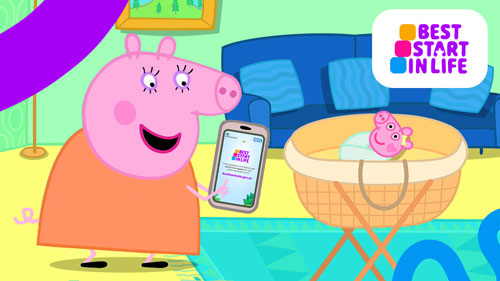
Millions of parents of children under four years old can now access trusted, NHS-approved early years advice thanks to a new government-backed series featuring Peppa Pig’s beloved family. A landmark campaign from the Department for Education, the Department of Health and Social Care, and Hasbro is bringing government and NHS-approved Early Years advice to parents through Best Start in Life, the government’s online hub for families.
The collaboration sees the UK Government team up with the much-loved Pig family, who star in bespoke animations available on the Muddy Puddle Parenting YouTube channel (Peppa Pig’s official channel for parents).
In the animations, Mummy and Daddy Pig explore common questions and challenges of being a parent – from infant feeding to early learning and preparing for school – while guiding families to visit www.BestStartinLife.gov.uk for trusted advice. There, they can also find details of local Best Start Family Hubs offering in-person support.
The latest in the animated series – created by production company Pink Static – recently launched on Muddy Puddle Parenting. The video guest-stars early childhood development expert Professor Sam Wass of the University of East London, featuring live-action scenes filmed at the University’s Institute for the Science of Early Years and Youth. In the episode, Mummy and Daddy Pig really struggle to soothe a crying baby Evie, and call on Professor Wass for expert advice and reassurance.
Olivia Bailey, Minister for Early Education says:“Through our Plan for Change, we want to support families to get a record share of children school-ready by the age of five. Peppa Pig has been part of family life for a generation. When parents are already turning to her world for comfort, routine and reassurance, it makes sense to meet them there. This campaign uses familiar characters to guide parents towards trusted, NHS-approved advice, whether they’re navigating sleep, feeding or early learning milestones, through Best Start in Life and local Best Start Family Hubs. By making support easier to find and easier to trust, we’re helping parents give every child the best start in life, wherever they grow up.”
A new advertising campaign on ITVX video-on-demand, featuring the first ‘Parent Coaster’ animation was created exclusively for the campaign. Peppa Pig’s large presence across retail and attractions will also be harnessed by the campaign by placing Best Start in Life resources directly into parents’ hands – through eye catching leaflets in Peppa Pig stores and at Peppa Pig World in Paultons Park.
Professor Sam Wass, Director of the Institute for the Science of Early Years at the University of East London, who stars in the latest animation, adds: “Parents play a vital role in shaping their child’s development during the early years. Simple, everyday interactions – like bonding, chatting and playing – can make a big difference, helping children build the skills and confidence they need to start school ready to learn. To support parents, it’s essential that trusted information and professional advice are easy to access, both online and within local communities.”
Since launching in October 2025, Best Start in Life has made a significant impact with its debut campaign film The Story of You, scripted by children’s author Camilla Reid and starring famous parents. Now a mum of three, Mummy Pig appeared alongside Oti Mabuse and Billie Shepherd, – achieving more than 500,000 views across social channels to date.
Esra Cafer, Global Franchise Strategy & Management, Preschool & Fashion at Hasbro says: “The Peppa Pig family continues to represent real-world family life and all of its joys and struggles, resonating with parents and preschoolers everywhere. With characters that reflect the campaign’s target audience, this campaign demonstrates how much storytelling and trusted characters can do to support parents with information that really matters.”
Health Minister Baroness Merron adds “Peppa Pig is already a familiar face in living rooms across the country, loved by millions of young children and their families. This campaign is a brilliant opportunity to reach parents with trusted NHS-approved advice to help give every child the best start in life.”
Find out more at www.beststartinlife.gov.uk