
Category

Music and singing

Live is best

By dance & Art, fun for children, Music and singing, Theatre

With the summer holidays around the corner, there is a bit more time to treat children to a trip to see a live performance at your local theatre. Younger children will enjoy a show during the day, and you can take older children in the evening without worrying so much about getting them to bed on time.

Many theatres have more shows on for children during the school holidays and may also run workshops for those who want to get more involved.

Live theatre can be a magical and memorable experience but recent research by Birbeck, University of London, has also shown that taking youngsters to watch a theatre performance could provide a host of developmental benefits, including improved emotional intelligence and opportunities to discuss difficult subjects.

It is now widely accepted that play-acting and role-play is a fundamental part of development, allowing children to engage in different personalities, work their way through complex social relationships and navigate emotional issues. Watching a live performance can offer some of the same benefits. Many of the shows aimed at children have an under-lying moral message and subjects such as love, friendship and bullying are often explored in a fun and safe environment, which can bring about unexpected but important conversations once the show has finished.

Going to the theatre as a family is also a great bonding experience. Parents don’t have to worry about entertaining their children (it’s being done for them on the stage) and everyone can relax, sit back and enjoy the show together. There are all sorts of shows on at local theatres during the summer. Some shows are for the very young and are short and interactive to keep little ones engaged, while others are full length plays aimed at older children. Many shows are now based on children’s favourite books such as The Very Hungry Caterpillar or books by David Walliams or Jacqueline Wilson. There are also live performances and sing-a-longs of films such as Frozen or children’s favourite television shows. These can be a good first introduction to the theatre for young children as they will be very familiar with the story and characters.

In order to get the most out of any show, get children excited and looking forward to the show in advance. If the show you are going to has a soundtrack, you could listen to it in advance. This is a great way to get children familiar with the show without overloading them with too much information. If you know the basics of the story, you could tell it at bedtime the night before so children will know what to expect, but family-friendly shows are normally easy to understand.

Going to see a live performance is a truly memorable experience and it is a wonderful way to spark a child’s imagination – you never know where it may lead them!

Kids Week in the West End

Kids Week in London is a wonderful opportunity to see a West End show.
The price of West End theatre shows puts it out of reach for many people, but Kids Week makes it far more affordable and is a way of encouraging families to go to the theatre.

A child aged 16 or under can go free to any participating show when accompanied by an adult paying full price, and you can buy up to two extra children’s tickets at half price. And there are no booking or postage fees to pay! It has proved so popular that it is no longer just on for a week, but for the whole of August.

Tickets are now on sale. The top shows sell out very quickly, but you can normally pick up tickets for the lesser known shows fairly easily and perhaps see something that you may not normally go to.

For further details go to www.officiallondontheatre.com/kids-week

Hitting the high notes!

By dance & Art, Education, fun for children, Music and singing, play

Experienced music teachers Sam Dixon and Carolyn Hextall, who run the music department at Brighton College Nursery, Pre-Prep & Prep School, sing the praises for a subject that is becoming increasingly sidelined in many schools.

music for childrenMusic helps us learn
No one doubts that learning music is fun. Sometimes, however, this concept can belittle the advantages that learning music brings and leads to it being given less emphasis in schools than other subjects. Research has shown that being taught music enhances skills such as concentration, memory and focus as well as offering physical and creative benefits to children. Similarly, an increase in the number of teaching hours dedicated to music and the provision of instrumental lessons for pupils can result in overall school improvement.

Busting the myth
There is a common misconception that those who achieve great results in music are naturally talented or gifted. It is a myth that often discourages children, or parents from families without a musical history, to embrace music as a subject. Music is a discipline just like sport or, let’s face it, any subject where success is achieved by children because they enjoy it and are therefore happy to dedicate time and energy to it. Enjoyment and dedication; these are two essential ingredients.

An early start
It is never too early for children to enjoy music and to start performing. Children as young as three can start to learn written notation presented in a fun, active way. Introducing them to the ‘Musical Family’ of Grandpa Semibreve, Daddy Dotted Minim and Baby Crotchet help to bring the notes alive. They learn the musical value of each note by physically moving in a way that suits the different characters; slow footsteps mark out the four beats of Grandpa Semibreve, whilst Daddy Dotted Minim loves to waltz – the children absolutely love the characters and the information sticks.

Keep it moving
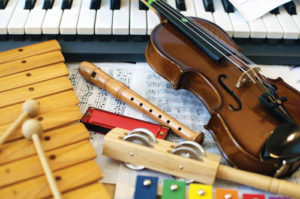
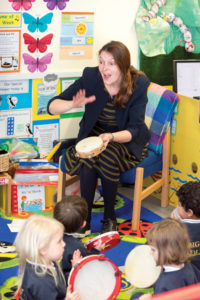
Methods such as this introduce the body as an instrument and our youngest pupils begin to connect music with movement, the mind with the body. Note recognition becomes physically embodied at a tender age and this helps to combat any trepidation surrounding their learning to ‘read’ music when they are older. Pulse and rhythm can also be embedded as early as possible through the use of dance along videos and regular opportunities to use simple percussion instruments or even the banging of a humble bucket. Singing is fundamental to the development of ear training
and use of the solfege system helps children to improve their vocal control and develop a strong understanding of the musical scale.

The show must go on
The fundamental principle of performance underpins music teaching at all levels and learning an instrument or singing gives children the opportunity to become involved in musical ensembles, performing with one other, and to explore a wide range of repertoire. Participation in ensembles as varied as orchestras, jazz and swing bands, percussion groups, pop groups, guitar, classical and piano ensembles are a brilliant ways for children to develop the important skills of listening, responding and analyzing. They allow children to work on the art of preparation and offer them vital performance opportunities on all scales.

Technology in music
When composition is introduced at a very young age, through call and response and simple improvisation children respond quickly to the introduction of songwriting, writing music to accompany films or music from particular genres. In a world where so much music is produced by technology, an understanding of notation and composition software such as Cubase and Sibelius is important and should be encouraged.

Making connections
Listening to a wide range of music and putting it into a historical and cultural context helps children to appreciate the links between music and other subjects being learnt at school.
So, when we listen to Baroque music and introduce pupils to the towering genius J.S. Bach, we consider what else was happening at that time. Who was on the throne in England and what was happening in Bach’s hometown? Was he a practical joker like Mozart or, like Handel, did he have a legendary temper? Researching contemporary pieces which use similar techniques, for example Goldfinger’s ‘Superman’ which uses a Baroque ground bass, makes their learning feel more relevant and accessible.

Onwards and upwards
Learning music is a three way process between parent, pupil and teacher. Each one relies on the other for their commitment, participation and development. Parents are key in providing a regular, realistic practice time for children who learn an instrument and ensuring it takes place in an appropriate environment. They can also help by exposing their children to a smorgasbord of different musical styles; it could be as easy as exploring the different channels on the radio, attending concerts or joining local choirs and community music groups. Music is such a wonderful thing to explore with children and parents really do not have to be the expert. If there is something you enjoy, share it with your children. An enthusiastic response to their practice efforts or dancing along to your favorite tunes is all it takes to get started.

Sam Dixon and Carolyn Hextall run the music department at Brighton College Nursery, Pre-Prep & Prep School educating over 500 pupils between the ages of three and 13 in curriculum music. Their provision is supported by a body of over 30 visiting instrumental music teachers who deliver individual and group lessons to the children.
www.brightoncollege.org.uk

Top tips for sleepovers

By dance & Art, family, Food & Eating, fun for children, Music and singing, parties, play
by Kitty Jones
The Dreamy Den Company

Sleepovers are a childhood staple but can be a daunting time for parents. Have no fear, we’ve put together some helpful tips and advice for a smooth sleepover experience.

1 Food
Hungry children are no fun so make sure you have plenty of food and snacks to keep them fuelled and happy. Self-serve stations are great fun and easy to prepare, try a burger bar, taco bar or a noodle/pasta bar with a selection of toppings and sides. Grab some recyclable ‘take-out’ boxes to minimise washing up.

2 Setting up camp
Living rooms are a good option due to size and TV access for movies but make sure pets can be relocated and the TV usage is monitored so they don’t stumble across any late night horrors by accident. And don’t forget to move any precious ornaments!

3 Midnight feast
This definitely doesn’t have to be at midnight – as hopefully everyone will be asleep by then! Consider having a break in the movie and doing a fruit fondue or a popcorn bar with a selection of toppings and sauces. Try some sugar alternatives to keep the sugar rush under control.

4 Entertainment
Garden games are great for summer and for burning off energy. For rainy days you can try DIY pamper packs or craft packs. Alternatively hire an external entertainer to come in and give you a few hours peace. Movies are great for later on and you can always have a pre-selected list to minimise arguments.

5 Nervous children
Be open and discuss action plans with parents beforehand, especially if a child has never been to a sleepover before. Make sure you know where each child’s parent will be and always get two contact numbers from parents.

6 The morning after
Choose your collection time as mid-morning giving the children a chance to have breakfast and, most importantly, don’t plan too much for the next day, you may all need a few impromptu naps to recover!