
by Marsha Dann
Lead Teacher, Play B C Preschool
A quality preschool, where there are well-qualified and experienced practitioners who give high priority to interacting with children and observing them closely in order to chart their development, responding to their needs and confirming and extending their learning, will enhance your child’s potential and give them an early advantage.
Supporting early childhood development
The Early Years are a crucial time in your child’s development. Scientists tell us that the brain develops rapidly in the first three years gaining up to 90% of its final mass and although the brain continues to develop into adolescence the best time for shaping brains is in the Early Years.
What your child learns in the Early Years is just as important as what they will learn in later years. Perhaps even more so because a good learning environment now can have a positive impact upon social, educational and behavioural outcomes that will last throughout their school years. Choosing a high quality preschool for your child can make a real difference to their future.
Building relationships
Look for a setting which focuses upon relationships rather than resources. The importance of relationships cannot be overemphasised. Attachment theory suggests that humans are born needing relationships with others. Secure attachments lead to independence and well-developed social skills. Social interaction helps to develop the brain and capacity for learning. A good preschool will value social development as highly as intellectual development. Positive relationships formed with caregivers, help develop a sense of security and provide a safe and secure base from which to explore the world.
The key person system helps children to feel valued and cared about by someone in particular while they are at preschool. It allows them to have someone, as developmental psychologist Bronfenbrenner puts it, who is ‘crazy’ about them. It has been acknowledged that people working in Early Years develop strong feelings for the children they care for and my opinion that is as it should be. Your chosen preschool’s team cannot be the same as family, but should come close.
Play based learning
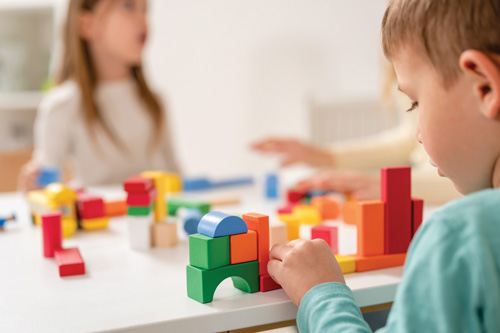
It is widely agreed, that children learn best through play. Childhood pioneers, such as Froebel and Montessori, identified play as being central to early learning. However, free play does not always move learning on, and a balance needs to be struck between spontaneous and structured play and also between child-initiated and adult-initiated learning experiences. Close observation of your child by practitioners will support development and help in planning developmentally appropriate, yet challenging, learning opportunities.
Narrowing the word gap
‘Reading and writing float on a sea of talk’. Lots of warm loving interactions and ‘serve and turn’ conversations with adults and peers will help to build vocabulary. Daily opportunities for songs, stories and rich structured talk at preschool will have a positive impact upon educational attainment and future life chances.
What does a quality preschool look like?
Educationalists identify two main aspects of quality in Early Years’ provision. The first aspect, which relates to processes, has the greatest impact upon outcomes. It is to do with adult interaction, responsiveness and appropriateness of activities. The second aspect, which relates to structure, has less of a direct impact upon outcomes but is important because it influences the processes identified above. It is to do with ratios and qualifications. Research shows that a well-qualified team is important and children make even more progress where a trained teacher is present.
Research evidence shows that quality preschool provision has a significant and lasting effect on educational, social and behavioural outcomes. Sending your child to preschool will get their education off to the best start.
Teacher-led Play B C in the Wallington and Carshalton area offers fun, yet challenging early education. More than just a place, at Play B C every day is a learning adventure. Contact info@playbc.co.uk to arrange a visit. www.playbc.co.uk

gular physical activity also has links to increased happiness, as well as giving children more opportunities to make friends and social connections.


If every opportunity is seized, there is wonderful scope for creating a powerful cross-curricular approach to developing a show. By learning about the literature, history, art, music, and dance that surrounds a story, we cultivate an appreciation for traditions, beliefs, design and stagecraft. As part of the preparations for our school’s recent production of The Lion King this term, the girls studied the patterns, designs and colours used in African prints before creating their own designs for fabrics, masks and marketing materials. They studied each character in the script and crafted symbols and emblems to represent them; meticulously forming links between characters who were related or belonged to the same group. Later, these were hand printed onto fabrics using block printing techniques so that they could finally be made into the cast’s costumes. Through workshops with external educators, they learnt about the importance and significance of symbolism in Adinkra printing; the rhythms and collective energy used in African drumming; and the storytelling techniques, as well as traditional movements, that can be generated through dance. We focused on the importance of recycling materials and made masks and props out of plastic milk bottles. This process was amazing – our girls were captivated by the transformation achieved with these simple objects. In addition to this, by singing songs in African dialects, we enhanced our understanding and appreciation of sounds and languages. The opportunities for extending the students’ learning through stimulating and interlinked topics are boundless.

I chose coeducational settings for my daughters because all of the above questions I asked so earnestly when they were three, and we were thinking about starting school, were just as relevant at senior transition and predictably as true now in adulthood. The difference now is that in life there is little or no option to choose a single sex environment and so rewinding to the start of school for them, I wanted them to be ready to understand what it feels to live, work and thrive in a coeducational environment. The careers that two of my daughters have subsequently chosen are traditionally male dominated ones and the fact that they earned their stripes in the classroom, alongside boys, means that they are well placed to prosper in these environments. They step forward, they know the value of their ideas and they allow no one, regardless of gender, to speak over them. It’s not easy but it is a skill carefully practised and honed and it is one which is being practised and honed in classrooms up and down the country.
Helping schools to enhance their outdoor learning offering and ensure children can enjoy meaningful and effective lessons, the Forest School Association offers a national accreditation that schools can apply for to deliver both structured and unstructured outdoor sessions. At our school, we have a long-established Forest School programme, led by our own Forest School accredited teachers and trainers, who are able to deliver valuable outdoor sessions for children from the age of two upwards.
r experience, we have found that outdoor learning is particularly beneficial for younger children. They are given the space to be active and enjoy being noisy and messy, while engaging in play-based learning and exploration. With activities based on small, achievable steps, spending time outside helps to increase self-confidence and independence in the early years. Additional benefits of outdoor learning for younger children include improving their focus and attention, while physically helping to improve their balance, co-ordination and fine motor skills.