
by Katie Malins, Director of Digital Learning, St Catherine’s Prep School, Bramley
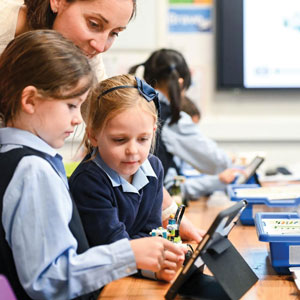
Step into a modern pre-prep classroom and you enter a space alive with curiosity and invention. Amongst the paints, puzzles and picture books, in one corner, a group of children huddle around a colourful floor robot, carefully debating which sequence of buttons will guide it through a maze they’ve designed.
Nearby, two four-year-olds frame the perfect photograph of their towering block creation, eager to capture their achievement. At a table across the room, another child narrates a story into a tablet, bringing their drawings to life with voice and movement. It is a classroom rich with imagination, collaboration and purposeful exploration – one that feels strikingly different from the classrooms many of us remember.
In the age of AI, this foundation matters more than ever. Our children are growing up in a world where technology does not simply support tasks, it performs them. This makes it essential that education focuses not just on using technology, but on understanding and thinking with it. Computational thinking – the ability to break problems into manageable parts, recognise patterns, follow and create sequences and refine solutions – becomes a vital skill. In pre-prep, these ideas are introduced in playful, intuitive ways, laying the groundwork for more complex thinking later on.
Starting early doesn’t mean accelerating childhood or replacing play with screens. Quite the opposite. The pre-prep years offer a golden opportunity to introduce technology in a way that feels natural, creative and empowering. At this age, children are open to exploring, experimenting and asking questions. Computing simply becomes another language through which they make sense of the world.
What’s important to understand is that computing in the early years looks nothing like the structured ICT lessons of the past. There are no keyboards clattering or lines of code to memorise. Instead, the focus is on the building blocks of computational thinking – skills that children already use instinctively. When a child sorts shells by size, they’re organising data. When they follow steps to wash their hands, they’re learning sequencing. When they try to fit a puzzle piece, realise it doesn’t work and try again, they’re debugging. Early computing gives these natural instincts a meaningful and modern context.
Floor robots and visual programming apps offer an introduction to direction, sequencing and problem-solving. This is coding in its simplest, most joyful form. Because it is rooted in play, children engage with it wholeheartedly, without fear of failure.
Digital storytelling is another powerful strand of early computing. Using simple apps, children can draw characters, record their voices and bring ideas to life on screen. This blend of creativity and technology helps them understand that digital tools are not just for consuming content. They are for creating, imagining and expressing. A child who narrates their own digital story is not only learning about technology; they are building confidence, communication skills and independence.
Alongside these technical foundations, it is equally important to nurture the human skills that technology cannot replace. The 4 Cs of 21st century learning (critical thinking, creativity, collaboration, and communication) are woven throughout pre-prep computing. Children learn to think critically when solving problems with a robot, to be creative when designing digital stories, to collaborate when working in pairs and to communicate when explaining their ideas. These are the qualities that enable them to thrive alongside AI, not be overshadowed by it.
What makes computing in pre-prep so powerful is that it doesn’t sit in isolation. It weaves naturally into literacy, maths, art, PSHE and even physical development. A robot journey becomes a storytelling adventure; a photo project becomes a science investigation; a drawing app becomes a way to explore shape and colour. Teachers design these experiences thoughtfully, ensuring that technology enhances learning rather than replacing traditional play. The goal is always to support the whole child: cognitively, socially and emotionally.
The world our children will inherit is evolving rapidly. We’ve heard time and time again that many of their future jobs do not yet exist. What we do know is that they will need to think computationally, act creatively, solve problems, collaborate effectively and adapt with confidence. By introducing computing in a way that is playful, purposeful and age-appropriate, we are not preparing children for a world of screens, we are preparing them for a world of possibilities.
So if you have ever wondered whether young children really need computing in their early years, the answer is both simple and reassuring. They do not need it simply because the world is digital. They need it because it helps them grow – curious, capable and confident. Pre-prep computing is not about creating tech experts, but nurturing explorers, storytellers, problem-solvers and creative thinkers, equipped with both the computational understanding and the human skills to flourish in the age of AI. That’s something every parent can celebrate.
St Catherine’s Prep School extends a warm welcome to parents who would like to visit the school.
Visit www.stcatherines.info to find out more about upcoming open mornings and arranging a visit.