Category

Artificial intelligence

Students-ipad

Growing digital explorers Why computing in pre-prep matters more than ever

By Artificial intelligence, Digital

by Katie Malins, Director of Digital Learning, St Catherine’s Prep School, Bramley

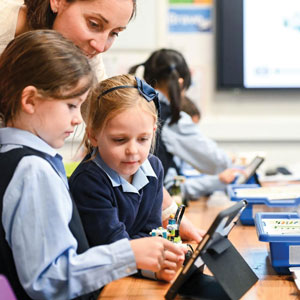
Step into a modern pre-prep classroom and you enter a space alive with curiosity and invention. Amongst the paints, puzzles and picture books, in one corner, a group of children huddle around a colourful floor robot, carefully debating which sequence of buttons will guide it through a maze they’ve designed.

Nearby, two four-year-olds frame the perfect photograph of their towering block creation, eager to capture their achievement. At a table across the room, another child narrates a story into a tablet, bringing their drawings to life with voice and movement. It is a classroom rich with imagination, collaboration and purposeful exploration – one that feels strikingly different from the classrooms many of us remember.

In the age of AI, this foundation matters more than ever. Our children are growing up in a world where technology does not simply support tasks, it performs them. This makes it essential that education focuses not just on using technology, but on understanding and thinking with it. Computational thinking – the ability to break problems into manageable parts, recognise patterns, follow and create sequences and refine solutions – becomes a vital skill. In pre-prep, these ideas are introduced in playful, intuitive ways, laying the groundwork for more complex thinking later on.

Starting early doesn’t mean accelerating childhood or replacing play with screens. Quite the opposite. The pre-prep years offer a golden opportunity to introduce technology in a way that feels natural, creative and empowering. At this age, children are open to exploring, experimenting and asking questions. Computing simply becomes another language through which they make sense of the world.

What’s important to understand is that computing in the early years looks nothing like the structured ICT lessons of the past. There are no keyboards clattering or lines of code to memorise. Instead, the focus is on the building blocks of computational thinking – skills that children already use instinctively. When a child sorts shells by size, they’re organising data. When they follow steps to wash their hands, they’re learning sequencing. When they try to fit a puzzle piece, realise it doesn’t work and try again, they’re debugging. Early computing gives these natural instincts a meaningful and modern context.

Floor robots and visual programming apps offer an introduction to direction, sequencing and problem-solving. This is coding in its simplest, most joyful form. Because it is rooted in play, children engage with it wholeheartedly, without fear of failure.

Digital storytelling is another powerful strand of early computing. Using simple apps, children can draw characters, record their voices and bring ideas to life on screen. This blend of creativity and technology helps them understand that digital tools are not just for consuming content. They are for creating, imagining and expressing. A child who narrates their own digital story is not only learning about technology; they are building confidence, communication skills and independence.

Alongside these technical foundations, it is equally important to nurture the human skills that technology cannot replace. The 4 Cs of 21st century learning (critical thinking, creativity, collaboration, and communication) are woven throughout pre-prep computing. Children learn to think critically when solving problems with a robot, to be creative when designing digital stories, to collaborate when working in pairs and to communicate when explaining their ideas. These are the qualities that enable them to thrive alongside AI, not be overshadowed by it.

What makes computing in pre-prep so powerful is that it doesn’t sit in isolation. It weaves naturally into literacy, maths, art, PSHE and even physical development. A robot journey becomes a storytelling adventure; a photo project becomes a science investigation; a drawing app becomes a way to explore shape and colour. Teachers design these experiences thoughtfully, ensuring that technology enhances learning rather than replacing traditional play. The goal is always to support the whole child: cognitively, socially and emotionally.

The world our children will inherit is evolving rapidly. We’ve heard time and time again that many of their future jobs do not yet exist. What we do know is that they will need to think computationally, act creatively, solve problems, collaborate effectively and adapt with confidence. By introducing computing in a way that is playful, purposeful and age-appropriate, we are not preparing children for a world of screens, we are preparing them for a world of possibilities.

So if you have ever wondered whether young children really need computing in their early years, the answer is both simple and reassuring. They do not need it simply because the world is digital. They need it because it helps them grow – curious, capable and confident. Pre-prep computing is not about creating tech experts, but nurturing explorers, storytellers, problem-solvers and creative thinkers, equipped with both the computational understanding and the human skills to flourish in the age of AI. That’s something every parent can celebrate.

St Catherine’s Prep School extends a warm welcome to parents who would like to visit the school.

Visit www.stcatherines.info to find out more about upcoming open mornings and arranging a visit.

computer class

Demystifying tech in education – Ethical, balanced and creative

By Artificial intelligence, Digital, Education
by Mrs Anna King
Senior School Headmistress, Notre Dame

In recent months, there has been a growing wave of national conversation around educational technology and Artificial Intelligence (AI) used in schools. What is its role? Is it safe? What are the risks and rewards? Any forward-thinking school will be refining and embracing its approach and values regarding the use of technology in the classroom.

Educational technology, or Edtech, refers to digital tools used in teaching and learning, not to be confused with social media or recreational screen time. When Edtech is used in a principled and pragmatic way, it compliments learning in a more engaging and innovative fashion. The use of technology in the classroom should not be driven by trends or devices for their own sake; instead, it should be used thoughtfully, where it enhances learning and supports the development of key skills for life.

Teachers should have the autonomy and expertise to select the most effective methods for each lesson, whether that involves digital tools or more traditional approaches. Across every subject, from science and mathematics to English and the arts, technology can be used as one tool among many. What matters most is its impact: does it deepen understanding, support memory and recall, or nurture vital skills such as collaboration, creativity and resilience? For example, in art and design, students might begin by sketching ideas on paper, then explore digital media platforms to transform their vision, layering images, experimenting with textures and curating digital portfolios that reflect both originality and technical skill. The blend of traditional technique with digital innovation is one of the many ways children are empowered to be creative thinkers and makers in a fast-changing world.

Similarly, in design and technology and computing, schools can foster an understanding of ethical innovation, encouraging students to think about not only what technology can do, but what it should do. This questioning mindset is essential, particularly as developments in artificial intelligence (AI) continue to reshape the educational and professional landscape.

Many schools opt to have a system where students have access to specific laptops or tablets, so they all have the same devices with the same safeguarding protocols in place. This level playing field helps to keep school communities safe while allowing consistent access to learning tools. Some schools use digital learning hubs, which offer students a structured space for classroom resources, teacher feedback, group work and self-paced study. Whether they are preparing for a presentation or revisiting a science experiment, children are learning not just what to learn, but how to learn independently and collaboratively.

Schools are also increasingly encouraging safe, appropriate and responsible use of AI tools with their older students. Under staff guidance, children can understand how AI can assist in their learning journeys, whether that is generating personalised practice questions, building flashcards for revision or helping them understand complex topics through different explanations. This use of AI is not a shortcut; it is a stepping stone, training students to be critical thinkers in a digital age.

Whilst schools embrace the benefits of technology, we should never lose sight of the power of tech-less learning. Writing by hand remains an essential skill, not only for public examinations but also for cognitive development. The act of drafting, drawing, mind-mapping or annotating by hand allows for a kind of reflection that typing does not always replicate. Plenty of pen and paper learning should always be encouraged throughout schools.

Learning at Notre Dame also extends far beyond screens and classrooms. Our students are encouraged to move, to create, to question. Our approach to technology is not just about keeping pace with the modern world. It is about preparing our girls to shape it with wisdom, integrity and imagination.

Find out more at www.notredame.co.uk, call our friendly Admissions Team on 01932 869993 or e-mail us at admissions@notredame.co.uk

Dandelion blowing

Artificial Intelligence and education

By Artificial intelligence, Education
by Mrs Sarah Bakhtiari
Principal of Shoreham College

Artificial Intelligence (AI), once confined to the realms of science fiction, is now a reality that permeates many aspects of our lives. It quietly operates in plain sight, through chatbots and virtual assistants, as well as in ways which remain largely unseen. For example, assisting in diagnosing diseases, analysing medical images and predicting patient outcomes. In the field of education, AI refers to the use of intelligent systems and algorithms to enhance teaching and learning experiences and so has the potential to enhance the way children learn and teachers teach. It encompasses various applications such as personalised learning, accessibility aids and the automated marking of work.

There is no doubt that AI is here to stay and while there is undoubtedly a storm raging about the relative benefits and challenges of AI, schools are diligently setting about exploring how AI can be used to enhance education. By embracing this technology we hope to empower our children with the skills and knowledge necessary to thrive in an increasingly digital society.

Personalised learning
AI enables educators to provide personalised learning experiences tailored to each child’s needs and abilities. Intelligent systems can analyse vast amounts of data to identify individual learning patterns, strengths and challenges. This information can be used to create customised learning paths, ensuring pupils receive targeted support. Adaptive learning platforms can utilise AI algorithms to deliver personalised content and track pupil progress.

In mathematics an AI platform can ‘learn’ a child’s mathematical strengths and challenges and provide content and questions aimed at building on those strengths and alleviating the challenges. The way that you might see this working in our classrooms is that a young person who is good at their times tables could have a ‘starter’ times table task to increase their confidence. They then progress on to long division, which they find more difficult – starting two steps behind the exact concept that the young person mastered in the last session, to build their confidence and move their learning forward. A teacher cannot reliably remember two steps behind, but the AI absolutely will. A master at the seven times table but always stuck on six times seven? Six times seven will come up again and again until it is cemented in the child’s long-term memory. This is powerful for moving concepts from the working memory to long-term schemas, which organise information according to how it is used and can be reliably recalled and built upon.

Enhanced collaboration and engagement
AI-powered tools can facilitate collaboration among children, encouraging teamwork and communication skills. Virtual reality (VR) simulations can transport children to historical events or scientific experiments, enabling them to actively participate and engage with the subject matter. AI chatbots can act as virtual tutors, answering questions and providing guidance, promoting independent learning and critical thinking. This does not replace real-life experiences; for example our Year 4 children will gain much from their annual trip to Bignor Roman Villa, but this can be supplemented with a virtual reality tour of one of the most significant proofs of Roman civilisation – Pompeii. We would happily take a secondary school trip to Pompeii, but never our Year 4!

Developing future-ready skills
As AI becomes increasingly prevalent in the workforce, equipping children with AI literacy is essential. By introducing AI concepts early on, schools can prepare pupils for the jobs of tomorrow. For example, coding platforms like Scratch or AI programming languages like Python can introduce children to the fundamentals of AI and computational thinking. This knowledge empowers them to become creators rather than mere consumers of technology, fostering innovation and problem-solving abilities.

When used most effectively AI complements, rather than replaces, existing relationships and teachers. Maintaining a strong teacher-pupil relationship is essential for effective education. By leveraging AI’s capabilities while preserving human relationships, educators can harness the power of technology to enhance learning outcomes and prepare children for the challenges of the future.

While AI can provide personalised instruction, it cannot replace the empathy, emotional support and mentorship that teachers and teaching assistants offer. Striking the right balance between AI and human interaction is crucial to ensure holistic learning experiences.

The integration of AI in primary schools offers a multitude of opportunities for our children’s education. By embracing this technology, we can provide personalised learning experiences, foster collaboration and equip our children with the skills necessary for success in the future. At our school, we support and encourage the thoughtful integration of AI, helping to ensure that our children are prepared to navigate the ever-evolving digital landscape with confidence and creativity.

Please call 01273 592681 to find out more about what Shoreham College can offer you,

or to arrange a personal visit at any time of the school year.
www.shorehamcollege.co.uk