Category

Early Years

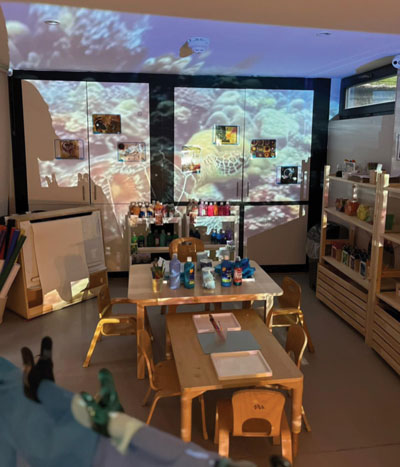
ocean fishtank scene

Nurturing creativity

By Early Years, environment, Forest School, Green, Mental health
by Karen Borley
Senior Education Advisor, N Family Club

The magic of the atelier and self-expression in the Early Years

In their early years, children establish the foundations of how they view the world, relate to others and express themselves. One way to support this development is through the use of an atelier, which is a dedicated space for self-expression. Inspired by the Reggio Emilia approach to early childhood education, the atelier is a vibrant, ever-evolving environment where children of all ages can make sense of their world through art, play and sensory discovery.

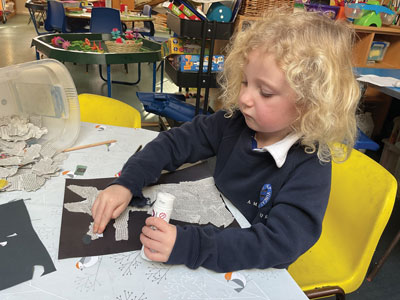
The atelier concept comes from the Reggio Emilia approach, a renowned educational philosophy that places high value on children’s natural creativity. Reggio educators refer to the variety of ways that children interpret the world as the ‘hundred languages of children’ with the environment as the ‘third teacher’. Aligning with the Early Years Foundation Stage’s (EYFS) Expressive Arts and Design area, an atelier can facilitate the ‘hundred languages’ through 2D and 3D art, clay modelling, transient art, photography, music and sound, amongst other experiences. Children are free to experiment, to combine different mediums, to revisit ideas and to create without the pressure of a ‘right’ answer. Essentially, the journey matters as much as the end result.

When set up thoughtfully, as a dedicated room or as a part of the main family room, the atelier should invite exploration, curiosity and wonder in children of all ages. Experiences and materials can be adapted to suit a child’s stage of development – whether it’s a toddler squishing clay between their fingers or a preschooler constructing a 3D sculpture with the same materials, the atelier should welcome all forms of expression and creativity. For babies, an atelier experience might be about sensory exploration – watching light and shadow, listening to soft music or touching different textures. For toddlers, it could be about mark-making, experimenting with colour, or stacking and building. Older children may work on more complex projects involving design, sculpture and collaboration. Every child has the opportunity to develop confidence in their ideas, to try new techniques, and to build something uniquely theirs.

In the atelier, children can be introduced to a diverse range of artists whose work sparks curiosity and wonder. Artists such as Joan Miró, Jackson Pollock, Henry Moore and Yayoi Kusama can be explored. For example, a child might respond to Kusama’s dots with their own vibrant pattern work. These experiences help children see themselves as artists, too. They learn that art is not about perfection but about expression – finding their voice, rhythm and mark in the world.

The atelier is also a space for project work – an opportunity for deeper, shared discovery. Children can return to their creations over days or even weeks, adding layers of thought, materials and meaning. This ongoing process demonstrates to children that their ideas matter and deserve both time and attention. Educators should play a key role here, introducing new materials and techniques, asking thoughtful questions and helping children to connect their experiences to broader ideas. Older children can be provided with the opportunity to collaborate with one another by discussing plans and building together, and these early experiences of teamwork and communication lay strong foundations for emotional and social development.

An important aspect of the atelier approach is documentation. Children’s creations should not just be displayed, but also celebrated. Photos, notes and collections of work allow children to revisit past experiences, reflect on their process and share their stories with peers and their families, supporting a sense of ownership and pride. By giving children the freedom and tools to express themselves, we help nurture confident thinkers, communicators and lifelong learners. In the safe, inspiring space of the atelier, each child is invited to tell their story in their own unique way. For families, knowing that such a space exists in their child’s nursery can offer reassurance that their child is being seen, heard and valued every day.

Founded in 2017, N Family Club set out to rethink Early Years education – developing a progressive curriculum, building a sector-leading team culture, and a world class service that adds real value for families. A proud B Corp, N Family Club were rated the highest quality nursery group in the UK by Nursery World in 2022 & 2023 and were accredited as a Great Place to Work in 2024. www.nfamilyclub.com

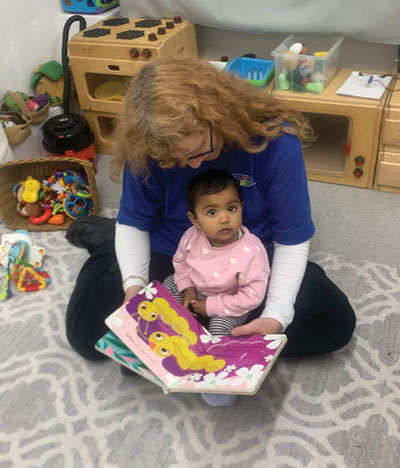
baby in arms

Choosing care for under twos – What really matters

By Childcare and Nannying, Early Years, Education, Relationships
by Marsha Dann
Lead Teacher, Play B C Preschool

Choosing childcare is one of the biggest decisions a parent can make. Unlike with preschool-age children, where the benefits of socialisation and learning through play are often more obvious, sending a child under two to a setting can feel more emotional and uncertain.

Yet, with more families needing to balance work and care, the expansion of funding and increased awareness of the importance of early childhood development, high-quality provision for babies and toddlers has never mattered more. But what does ‘high-quality’ look like for the very youngest children, and what should parents be looking for?

A different kind of care
Caring for children under two is a vitally important job. The brain is developing at its most rapid rate and the wiring for emotional security, resilience and lifelong learning is being laid.

While environment and resources can enrich experiences, the most important thing to focus on is relationships. Very young children need warm, responsive, attentive adults who can tune into their needs, often when they cannot be expressed in words.

That is why the key person approach is so important. Each child should have an adult who forms a close, secure bond with them, gets to know their routines, and becomes a safe base for them from where they can explore their environment. Babies and toddlers feel safest when they know someone consistent, who is practically and emotionally available is caring for them.

When visiting a setting, ask:
• Who will be my child’s key person?
• What is your approach to settling in?
• How do you respond to children’s emotional needs throughout the day?

Look for teams who talk with genuine warmth and understanding about the children in their care. A well-organised rota or impressive curriculum means little if relationships are not at the heart of practice.

Nurturing the whole child
At this stage, learning does not look like reading or writing, but like exploration, imitation, repetition and lots of sensory play.

Young children develop through hands-on experience: mouthing, banging, pouring, crawling, climbing, and observing. Their muscles, coordination and cognitive abilities are all growing rapidly, and a good setting will reflect this through both their environment and adult-child interactions.

The best baby rooms are calm but active, warm but stimulating, and above all safe. Look for open-ended materials like baskets of natural objects, age-appropriate books, softplay zones, cause-and-effect toys and spaces for messy or sensory play. Outdoor access is especially valuable for crawlers and toddlers to explore safely in the fresh air.

Flashy equipment or over-stimulating gadgets are not necessary, babies will thrive on real-world experiences, warm conversation, and repetition.
Ask:
• How do you plan for children’s individual interests and development?
• Do babies go outside every day?
• What types of sensory and physical play do you offer?

Feeding, napping and routines
Consistency and routine are comforting to under twos, but they also need flexibility and responsiveness. Babies grow fast, and their needs can change rapidly. A good setting will blend a rhythm to the day with personalised routines.

Whether it is bottle-feeding, baby-led weaning, expressing, or adjusting nap schedules, look for a team that listens and works in partnership with you, individuality must be respected.
Ask:
• How do you manage different routines in the same room?
• Can I bring expressed milk / my child’s comforters / familiar sleep cues?
• How will you keep me updated during the day?

Communication is key
For parents of under twos, especially those leaving a baby in childcare for the first time, regular, meaningful communication is essential. Look for settings that prioritise updates, welcome conversation, and invite you into your child’s day. This might include handovers, learning journals, photos, or daily diaries but should always feel two-way, and not be just a formality.

Trust builds when you feel your child is truly known, and that you’re working as a team with their educators.

Staffing matters
Ratios and training are particularly important for babies or young toddlers. Legally, there must be one adult for every three children under two years, but good settings often go beyond minimum standards, especially during busy times of the day.

Equally important is the experience and stability of the team. Young children need familiar faces and confident, skilled adults who understand child development, attachment, and how to support emotional regulation.

Ask about staff turnover, training, and how the team is supported. High quality for under twos is built on a culture of care and continual reflection.

Making your choice
Choosing care for your baby or toddler is deeply personal. Trust your instincts when you visit a setting: Do the adults get down on the children’s level? Is the environment calm but engaging? Do you feel listened to, not just spoken at?

Opt for a setting where relationships, not routines, are at the heart of everything they do and you know your child will be seen, heard, and known.

Marsha Dann, lead teacher at Play B C Preschool, making every day a learning adventure in Wallington and Carshalton.
www.playbc.co.uk
info@playbc.co.uk

happy baby in class

The challenges faced by the Early Years sector

By Childcare and Nannying, Early Years, Education
by Becky Chapman
Kiddie Capers Childcare

Over the past few months, the Early Years sector has been at the forefront of the media. A sector, which was already under significant pressure, now faces additional financial and operational challenges.

Early Years education is not only crucial to society, but research shows that children who spend longer in an Early Years provision, have better outcomes later in life. That’s why we fully support the expansion of government funding for children aged nine months plus from September 2025 – we’re one step closer to ensuring that every child in the country has access to high quality, affordable and flexible childcare that meets every individual’s needs.

The support that this expansion in funding brings to working families is fantastic – it’s hard to remember that just a year ago there was limited funding available to families.

But we felt it important to share an insight into life in Early Years, to ensure parents and carers understand some of the challenges we face in the sector daily.

Attending nursery is so much more than just ‘childcare’ – it forms the basis of their early learning journey and is fundamental to their future. Experienced practitioners deliver the Early Years Foundation Stage curriculum (EYFS), which covers birth to five years, ensuring all children in their care are exposed to critical life skills.

Here, we pride ourselves on developing a range of educational activities and outdoor adventures, led by children’s curiosity, to spark their imagination and foster a love of learning and the world around us. Through regular assessments, and parental involvement, we encourage independence and can further identify and support those with additional needs.

It’s no secret that rising costs have impacted everyone across the country, and the Early Years sector is no stranger to this. Rising operational costs, increases to minimum wage and employers’ national insurance contributions, alongside funding that doesn’t cover the true cost of a child’s place at nursery, have led to many businesses, some of whom have been operating for decades, sadly having to close their doors for the last time – often in the areas that need them the most.

Providers are facing tougher constraints from their local authorities in an already heavily regulated world, making it increasingly difficult to deliver high quality education within tight financial restraints. Providers must now balance these restrictions, such as how and when funding can be used, with the known financial impact to ensure their business remains viable. Providers want to remain as flexible as possible to meet the requirements of the families they provide such a valuable support to, but sometimes they are restricted. It’s important to check the fee structures and funding models for each nursery to check how much funding can be used per day based on the hours you require care for, as this will vary from nursery to nursery and will impact your total monthly invoice.

With the increase in funding available, providers are naturally seeing a decline in families who are paying for additional hours of care, leaving sometimes a significant gap in income. This has sadly left providers without a choice but to have to introduce a ‘consumables’ charge to go some way to help cover the costs that a nursery incurs, but government funding does not cover – such as snacks, nappies (where required) and external trips. This also allows nurseries to be able to continue to deliver vital sessions (such as Forest School), which are considered above and beyond the EYFS curriculum and so important to a child’s learning.

Early Years providers are having to adapt by being innovative, streamlining their operations and exploring new funding models whilst working to those strict provider agreements. Providers have had no choice but to pass on some of their increased costs to parents through fee increases, and necessary ‘consumable’ charges to support the delivery of the EYFS, or make a loss and ultimately face closure, something that no provider wants to do. It’s about survival and being able to continue to do what we love, providing a truly valuable Early Years education to the next generation.

Something that not many parents and carers will realise is that funding rates vary across the country. Yes, the government set out overall funding, but the hourly rates nurseries receive per child differs depending on your local authority.

Staffing to meet the needs of families is often another large concern for providers. Practitioners bring patience, creativity and empathy, but despite a recent Department of Education campaign, there is a distinct lack of qualified practitioners in the market and fewer people deciding that a career in Early Years is for them. Renumeration could be one factor, as this often doesn’t reflect the qualifications and skillset required for the role, or it could be the under-appreciated nature of the industry. We believe that happy staff = happy children, and that’s why we invest in our people as much as possible and have developed a sector leading benefits and renumeration package for our colleagues.

But it’s not all doom and gloom, working in Early Years is incredibly rewarding – no two days are the same and who wouldn’t want to work with children who are inquisitive and have such a love for life – we could all learn a lot from them!

We have no doubt that every family out there truly understands the value of a high-quality Early Years education and the integral part it plays in the UK education system – but there is a long way to go to ensure the sector is sustainable for the future.

In a sector which needs reform and significant further investment, we ask just one thing – please be patient and understanding. Everyone is doing their best and always putting the children first.

For anyone wanting to explore their funding options further, we recommend visiting the Childcare Choices website. It provides further information on entitlement, how to claim funding and other support available to parents (such as Tax Free Childcare) visit http://www.childcarechoices.gov.uk/whats-new

With settings located across Sussex, we’d love to hear from you – find out more about us at www.kiddiecaperschildcare.co.uk


ADHAD boy

Not everyone is “a little bit ADHD”

By Early Years, Education, family, Language, reading, Uncategorized

Expert psychologist tackles misunderstanding of growing condition

As the NHS grapples with an overwhelming rise in ADHD and autism self-diagnosis, Dr Selina Warlow, a leading psychologist specialising in neurodevelopmental conditions and founder of The Nook Clinic, is calling for an urgent shift in how we talk about ADHD. With more than 230,000 people in England now taking ADHD medication, and an estimated 2 million living with undiagnosed ADHD, she warns against dismissing the condition as “a quirky personality trait”.

Dr Selina is issuing a bold statement against the growing trend of trivialising ADHD as self-diagnosis soars across the country. Misunderstandings around the condition, she warns, risk dismissing the very real struggles faced by those affected. She points to the rise of ADHD being portrayed as ‘quirky’, could be a harmful narrative with social media platforms like TikTok contributing to misconceptions, where over half of popular ADHD videos contain misleading information.

ADHD is not a fleeting behaviour about being forgetful or fidgety, nor is it a fun social media trend – it’s a serious neurodevelopmental disorder that deeply impacts people’s lives. The casual remarks like “Isn’t everyone a bit ADHD?” belittle the real struggles individuals face in both personal and professional settings.

The NHS is reportedly struggling to meet the rising demand for ADHD assessments, with experts warning that mental health services can’t keep up. Since 1998, there has been a nine-fold increase in autism diagnoses and ADHD diagnoses are rising sharply. But, despite these statistics, ADHD continues to be trivialised, particularly through misleading content on platforms like TikTok – where 52% of the 100 most popular ADHD-related videos are inaccurate.

“The term ADHD is being thrown around as a quirk or personality trait,” Dr. Selina emphasises. “But for many, it’s a daily battle. Formal assessment and diagnosis and tailored support are critical to help people thrive, especially when nearly 80% of those with ADHD in the UK remain undiagnosed.”

With around 1 in 20 adults potentially living with ADHD, Dr Selina is calling for a national conversation grounded in facts rather than myths.“We need to move beyond casual self-diagnosis and ensure people who are struggling with symptoms of ADHD have access to assessments and support.”

Dr Selina’s expertise comes at a crucial time when the conversation around ADHD needs to shift from entertainment and myth to facts and support. She truly believes that we need to move beyond the stereotypes and support those living with the condition by recognising their strengths and providing the right support and care.

For further information about the Nook Clinic please visit www.thenookclinic.co.uk

child-feel-heard

Five tips to help your child feel heard

By Childcare and Nannying, Early Years, Language, Mental health
by Dr Naveen Puri
Medical Director, Bupa UK

1. Listen actively
It’s easy to overlook your children’s problems, especially when you’re busy or having a tough day. However, it’s important for them to know you’re ready to listen. Make sure to listen to your child without interrupting. Show that you value their thoughts by giving them your full attention, maintain eye contact, nod and respond to show you’re engaged.

This will help build trust and reassure them to share their feelings and challenges with you as they grow up.

2. Create a safe space
Look for chances to talk together. Sometimes, having a face-to-face conversation can be tough, so chatting while on a walk or during a car ride can make it easier as you’re not facing each other.

Remind them regularly that they can talk to you about anything, no matter how difficult, and that you won’t judge or blame them. Your child may not be ready to discuss something right away, so let them know you’re there to listen whenever they feel ready.

3. Look for clues in their play
When children become upset or stressed, they may show their feelings through play rather than words. For example, if your child is play fighting with their toys, don’t be afraid to call it out in a non-judgemental way, by saying things such as “There seems to be a lot of fighting today” or “That looks pretty scary”. This can encourage them to talk about what’s bothering them.

Don’t be discouraged if this doesn’t start a conversation. Having you around may help them feel more comfortable and make it easier for them to share their problems when they feel ready.

4. Use simple language
Talking about different feelings with your child is helpful for their emotional development. By using simple language, you can help them understand and express their emotions better.

Here are a few things to consider:
• Use clear emotion words
Stick to basic words like ’happy’, ‘sad’, ‘cross’ and ‘worried’. This helps your child easily identify and relate to their feelings.
• Label their emotions
When you notice your child expressing an emotion, it can be useful to help label it for them. For example, if they appear to be upset or crying, say, “You look sad”. This shows them that you understand what they are feeling and helps them learn to recognise their emotions.
• Encourage open questions
Ask open-ended questions that prompt your child to share their feelings. Instead of asking “Did you have a good day?” try, “What made you happy today?” This encourages them to think about their emotions and express themselves more fully.
• Share your own feelings
Healthily show your child that you feel emotions too. For example, say, “I felt worried this morning when I couldn’t find my car keys as I didn’t want you to be late for school.” This normalises talking about emotions and reinforces that it’s OK to be open about your feelings.

5. Acknowledge your child’s feelings
Even if you don’t fully understand what they’re going through, it’s essential to validate your child’s emotions and support their development. Here’s how and why this is beneficial:
• Recognising complex emotions
Experiencing a wide range of emotions can be overwhelming for your child. Whether it’s frustration over a difficult homework assignment or sadness after a disagreeing with a friend, try to recognise these feeling and help them understand that it’s OK to feel them. Reassure them by saying things like, “I see that you’re feeling upset about this” to show them that their feelings are valid and worthy of attention.
• Normalising emotions
Letting your child know that it’s normal to have different emotions helps them feel less alone. They may worry that their feelings are unusual or that they shouldn’t feel a certain way. Validate all their emotions by letting them know it’s OK to feel whatever they’re feeling, and that everyone has a range of emotions. This can reduce anxiety about their feelings and encourage them to express themselves more freely.
• Building trust and respect
Acknowledging and respecting your child’s behaviour helps them to learn that you take their feelings seriously. For example, saying something like, “I understand why you’re feeling this way, it makes sense”, reinforces that you value their views and what could be troubling them. This can help strengthen the bond between you both.

It’s also important to take a moment for yourself and reflect on your own feelings. Make time for activities you enjoy, spend quality moments with your child and keep a positive outlook. If things become difficult for you to cope with, remember to stay connected to people you trust. You may find it easier to speak to a health professional if you find it difficult to open up to those close to you.

For further information from Dr Naveen Puri, Bupa Medical Director please visit www.bupa.co.uk/health-information/health-blog/author-profile/m-p/naveen-puri

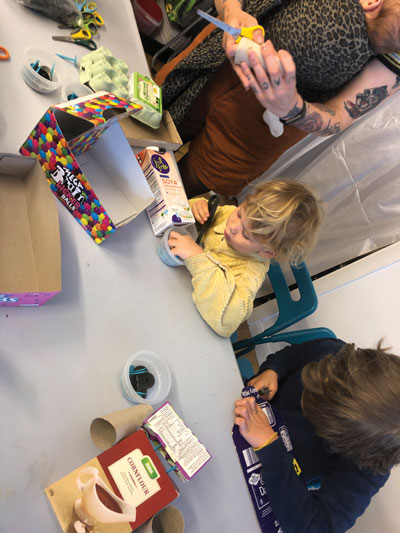
creative learning

Nurturing creative learning

By children's health, Early Years, Education, family, Forest School, Playing, Relationships
by Sharon Mee
Artpod Brighton

Creativity is the spark that fuels curiosity, innovation, and self-expression. For children and young people, engaging in creative learning is more than just an enjoyable pastime – it’s a powerful way to develop essential skills, build confidence and navigate the world. We’re passionate about making creative opportunities accessible to everyone, empowering children and families to unlock their potential through the arts.

What is creative learning and why does it matter?
Creative learning is about fostering a child’s imagination and encouraging them to think critically, solve problems and express themselves in unique ways. Unlike traditional rote learning, which often focuses on memorising and repetition, creative learning emphasises exploration, experimentation and personal growth.

The benefits are wide-ranging:
• Boosted emotional wellbeing: Creative activities provide an outlet for children to process emotions and reduce stress.
• Enhanced problem-solving skills: By thinking outside the box, children learn to approach challenges with confidence and flexibility.
• Improved social connections: Collaborative projects foster teamwork, empathy and communication skills.
• Celebration of individual strengths: Creative learning recognises and nurtures each child’s unique talents and abilities, especially for neurodiverse learners.

For neurodiverse children, creativity can be transformative. It provides a way to express feelings and ideas that may be hard to verbalise, and it allows them to develop skills at their own pace in a supportive, flexible environment.

How parents can foster creative learning at home
Creative learning doesn’t have to be confined to schools or workshops. With a bit of imagination, parents can create a home environment where creativity flourishes.

Here are some tips to get started:
1. Provide open-ended materials
Stock up on versatile materials like paper, paints, cardboard, glue or even household items like pasta and fabric scraps. Open-ended resources encourage children to invent, design and build without strict instructions.
2. Encourage curiosity and questions
Instead of giving answers right away, ask them questions like, “What do you think would happen if…?” or “How might you solve this?” to inspire creative thinking and problem-solving.
3. Dedicate time for play
Unstructured play is a cornerstone of creativity. Set aside time where children can explore their interests, experiment and let their imaginations run wild.
4. Incorporate creativity into everyday activities
Turn daily routines into creative opportunities – designing patterns while setting the table, inventing bedtime stories together or cooking meals as a collaborative ‘art project’.
5. Celebrate effort, not perfection
Encourage children to take risks and try new things, emphasising that mistakes are part of the learning process. Celebrate the effort they put into their creations rather than focusing on the outcome.
6. Explore the arts together
Visit museums, attend performances or explore virtual art galleries. Experiencing creativity as a family can inspire children to pursue their own artistic interests.
7. Join workshops and community events
Look for local workshops or online classes to expand your child’s creative horizons.

Creative learning is a gift for life
In today’s fast-paced, tech-driven world, creative learning is more important than ever. It gives children a sense of agency, helping them navigate challenges and find joy in self-expression. Whether at home or in one of our workshops, nurturing creativity is a gift that lasts a lifetime.

Explore a world of imagination with Artpod. Visit Artpod’s website to discover workshops, events and resources that bring creative learning to life for your family. Together, we can inspire the next generation of thinkers, makers and dreamers. www.artpodbtn.com

world

How to teach your children about the world around them – even when it’s doing its worst

By Early Years, environment, Forest School, Mental health, Relationships, Wellbeing
by Katie Harrison
Founder of Picture News

As our children grow, they become more aware of the world around them. Some events are sensitive and divisive, with global news often being unavoidable – including for children. Stories can be encountered online, on newspaper front pages, or via chatter in the playground. But what if the news didn’t have to be something to try to shield children from? As parents and carers, we can responsibly share current affairs with children, to equip them with tools to develop and learn from the world around them.

Make news discussions age-appropriate
Consider children’s age and developmental stage when planning your news discussions. You may wish to use visual content, including images and videos, but remember to vet these before sharing with children. For younger children, simplifying news events into relatable concepts, like being kind or unkind, fair or unfair can be effective. For older children, divulging more information can be appropriate. Reactions and understanding of news stories will differ for all children, but be confident that you know them best as you gauge how much information to share. News conversations can work well in the morning, to give children plenty of time to digest what’s happened, then reflect and share any questions or worries with you during the day.

Consider your role and influence
Be sure to observe and regulate your own reactions, language and behaviour when discussing news with children. As parents, we know children can be impressionable, and therefore may detect and emulate any fear or hatred they observe around them. We can responsibly ensure children mirror positive behaviour when discussing current topics. Try to maintain a healthy environment that is considerate and respectful. Think carefully about the language you use and try to stick to the facts. Be clear if parts of the discussion are your own thoughts, and be honest with children if you are unsure on a response to a question – you don’t have to know all of the answers! Instead, navigate the news together as events occur.

Help children work through their emotional responses
News stories can prompt emotional reactions for all of us. Some stories can dominate headlines and social media feeds or directly affect children, so it’s important to let them have emotional outlets in response. Children may bottle up how they’re feeling about events unfolding in the world, so making time to talk in a safe, familiar space can be of benefit. Give children a variety of tools to communicate how they feel; they might prefer to talk, write, or use creative approaches. You could use visual aids, discussions, post-it notes, emotion cards, smiley faces or art. Exploring how a news story makes your children feel can be a genuine opportunity to explore their understanding of emotions – what it means to feel an emotion, how emotions can change over time and how they manifest differently for everyone.

Support children to develop empathy
Current affairs contain a spectrum of opinions and experiences, which help children learn that we all hold different perspectives to be respected. This can support children in forging connections between themselves and others; by exploring other people’s experiences depicted in the news, children can build empathy, consider others, and practise relating to people. Such an awareness is a useful tool to help children become well-rounded, thoughtful citizens, who care about others.

Look for the positives together
Nestled within sensitive topics tend to be positive stories that follow. During times of hardship reflected in the news, we can often find examples of communities pulling together in response, which ultimately show our children lessons of morality, citizenship, and unity. So if you’re unsure how to approach a sensitive news topic with children, try sharing stories about more uplifting, responsive events that emerge. This helps you address heavier issues through an accessible, less unsettling lens. There are many positive acts that follow turbulent events we can share with children.

Inspire children to use their voice
Headlines are full of people using their voice to make a change – and children can do the same. Take the time to empower children to know that an awareness of what’s happening in the world can help them speak up as active citizens. The news is happening now, and with your support and guidance, children can act on their ideas and opinions. Whether it’s helping their community or writing letters, children can be encouraged to believe in their own ability to create positive change locally, nationally, or even globally.

There are many important lessons within news events that can help children grow and develop. Sharing the news with the younger generation comes with responsibility, but with the right tools and guidance, children can learn valuable lessons of citizenship, empathy and morality, whilst discovering the world they live in.

Katie Harrison is a former teacher and founder of Picture News, a supplier of teacher resources for creating engaging and exciting lessons about current affairs so children can learn about the world around them. For further information please visit www.picture-news.co.uk


forest school

Forest School- what is it all about and why is it so beneficial to children?

By Early Years, Education, environment, Forest School, Green

by Melanie Parr
Managing Director, Lymley Wood CIC

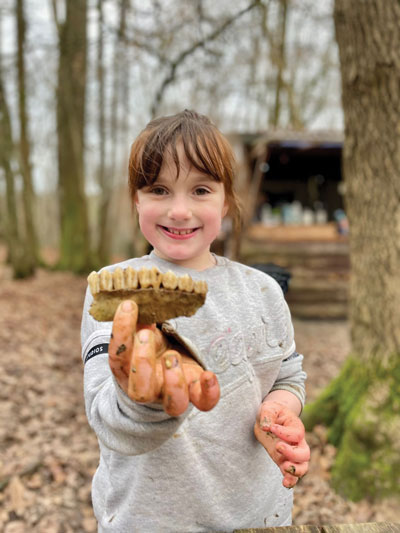
So many people are talking about Forest School at the moment, we thought it would be good idea to explain what it’s all about and why so many children benefit from a day out of the classroom, learning in nature. Forest School takes place in a woodland or natural environment and is aimed to support the development of a lifelong relationship between the learner and the natural world. Forest school is not just taking learning outside, it’s a unique and child centred way for children to learn using their innate curiosity about the natural world, animals and the joy of being allowed to get muddy!

The Forest School movement started in Denmark in the early 1950s as a result of a parent taking her own children and neighbours’ children to gather together in a nearby forest – an unofficial form of daycare which proved popular among other parents in the community. Arriving in the UK in 1993, today Forest School happens all around the world and in the UK has its own association (www.forestschoolassociation.org) that oversees the quality of provisions and provides training for Forest School leaders in order that the settings provide a well-planned, safe and inspiring curriculum for the children attending Forest Schools.

Forest School is a child-centred inspirational learning process, that offers opportunities for holistic growth through regular sessions. It supports play, exploration and supported risk taking. It develops confidence and self-esteem through learner inspired, hands-on experiences in a natural setting. This means that children attend regularly throughout the school year and the curriculum uses the changing seasons and the natural space to support learning. There is also a focus on helping children navigate the social and emotional aspects of learning and education, and for this reason, is a go to option for parents whose children may struggle at a regular school, or for those children who have special educational or additional needs.

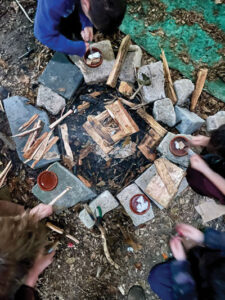
Some schools, especially primary schools, have added Forest School to the timetable but nothing is quite the same as the children accessing a woodland space rather than a school field or small area in the school grounds. Forest School is not a ‘subject’. Rather, it’s that all subjects can be taught in a fun and meaningful way but outdoors, Forest School style, instead of in a classroom. If we want to achieve a holistic education that uses play and nature rather than prescribed separated ‘subjects’, then freedom to be allowed to learn at their own pace and guided by a child’s own natural curiosity is key. Maths outcomes can be achieved through counting dug up worms or collected leaves or acorns just as well as with traditional classroom resources. Art lessons using self-made natural dyes and paints, or by creating some ‘land art’ is a fun way to learn creativity. PE on a rope swing, tree climbing or an adventure playground in the trees is a great physical ‘lesson’. Learning history through digging in mud for ‘archaeological remains’ or making a traditional tool using stones and sticks – it really brings learning to life.

A quality Forest School provider will also support children to learn how to manage their own risk and understand their own physical abilities or limitations. This builds safety skills, resilience and a sense of achievement as the children have freedom to undertake personal and physical challenges in a way where they can make their own decisions and are not distracted by parents’ fear or safety concerns.

Sussex has some great Forest Schools and a setting such as Lymley Wood can also help with families who need to access funding for children who have an EHCP, as their Forest School is an alternative education provision.

If your children are home educated or on part-time timetables then looking at Forest Schools is a fabulous forest schoolingoption to engage them in their own education.

Mel Parr runs Lymley Wood CIC based near Five Ashes, in East Sussex. For further details please feel free to call 07951 257813 or visit www.lymleywood.co.uk

baby biting

Help! My child bites…

By Early Years, Health, teeth and dental care

by Jovita Opio
Nursery Manager, Little Lancing Day Nursery & Forest School

Biting is a more common behaviour than one might think amongst very young children and it’s a topic that is not always spoken about very much, until it happens within your family. It can happen anywhere – in the home, at a soft play or play park, a child’s birthday party and of course in a childcare setting.

Biting can be a shock and it is certainly distressing – for the child or adult who has been bitten and the parents of a child who has been bitten who can understandably feel angry about it. It should go without saying that it is also upsetting for the parents of the child who has been biting.

Understanding about biting is vitally important to the way in which we respond to this happening – it is not the case that a child who bites is a ‘little monster’. He or she should not be punished for it, or worse still, bitten back. That’s not to say that this behaviour should simply be ignored. The following will help to explain why some children bite and what strategies can be employed to navigate a way through this behaviour.

Starting with the youngest of babies, as they begin to understand and engage with the world around them, they use all their senses as part of that natural exploration, and that includes using their mouths. Parents, carers and nursery staff all know that babies are inclined to put anything and everything into their mouths. It’s also a common feature of teething that babies will bite down on practically anything within reach to relieve the discomfort caused to their gums. It’s highly unlikely that children that young would deliberately bite another person with any kind of malice or ill feeling. In fact it’s sometimes the case that this is how they express their feelings of love – some babies only ever bite their parents!

As babies become toddlers, they continue to develop their language and communications skills and this happens at different times for different children. Some 18 month olds are real chatterboxes and others take more time to get to that stage. For those children whose language development occurs later, they may feel some frustration at not being able to express themselves and this can be a similar experience for children for whom English is an additional language.

Whenever children play together, there is inevitably a certain amount of disagreement that can creep in. For example, when both want to play with the same toy or when a child is blocking another child’s way, say on a slide or in a soft play environment. It’s a common reaction in such circumstances that a child may bite another child, or an adult, as they have not yet reached the point where they are able to express themselves verbally with the confidence to show their emotions.

Young children can find transitions and changes in their lives frustrating or stressful. For example, moving house, adjusting to changes in routine, the arrival of a new sibling as well as what might seem more mundane aspects of daily life, such as struggling to understand that they have to wait their turn to do something, or play with a particular toy, when they find it difficult to understand the concept of time. Biting can often be a response to relieving these frustrations and tensions.

It is also a possibility that some toddlers may find that biting focuses attention on them from adults and they see this as a reward. They are too young to differentiate between gaining attention through positive rather than negative behaviour. It’s also important to understand that children begin to realise that their behaviour (whatever it may be) can be a way for them to influence or control the environment or situation they find themselves in. Initially, biting can be a response to frustration or physical pain, but left unchecked, it may develop into a learned behaviour as a way of ending a situation they are not happy in or avoiding having to do something they do not want to do. It’s also the case that children at this stage of development may imitate all sorts of behaviours they see in others, and that includes biting.

Acquiring language and communication skills in turn leads into the stage in the early years development journey, where children begin to understand their emotions better and are more able to express themselves. This enables them to begin to self-regulate their responses to situations where they feel upset or angry.

So how best to deal with a situation when a child has bitten someone else?
For parents of the child who has been bitten, it’s understandable to feel anger and distress at what has happened. It’s all too easy to assume that the child who has been biting has additional needs (in most cases they don’t) and complaining to friends or other parents may not be helpful (and potentially embarrassing if your child then bites another person at another time). Discussing it with the parents of the child who has bitten may sometimes help understanding and clear the air but sadly this is not always a positive solution. If we are asking our children to be kind in their dealings with others, we should be kind too.

Parents of young children who bite often do not know where to turn or how to help their child through this stage. It can feel overwhelming but there is help at hand. They can turn to their Health Visitor for advice, and if attending an Early Years setting, the nursery staff will be supportive. Working with parents to devise strategies is key, as is consistency in approach to biting.

Whether at home with family or within an early years setting, there are a number of strategies that can help children through this stage in their development. These include:
• Praising and rewarding positive behaviour, so children don’t only get attention for negative behaviour.
• When a child bites another child, focus the attention first on comforting the child who has been bitten, so the child who has bitten does not receive priority attention. Remove them from the situation and make it clear with simple phrases such as “Stop. Biting hurts your friend. Biting isn’t kind.” The days of the ‘naughty step’ should be long past – in fact the word ‘naughty’ should not even come into the conversation.
• Providing sensory activities to create a similar experience to the biting behaviour and build these into a child’s daily routine – whether a ‘chew’ teething toy, such as a ‘chew buddy’, a ‘chew necklace’ or offering a healthy crunchy snack of fruit or vegetables.
• Redirecting a child’s attention to offer an alternative activity if they are struggling to regulate their response to a frustrating situation is a useful technique to defusing tension.
• Using visual prompts and storytelling to the children (at nursery this usually takes place as a group activity) helps them to learn. For example, if there has been an incident at a soft play, this can become the theme of a social story, using role play, such as puppets, to help children understand better positive strategies to use in social situations.
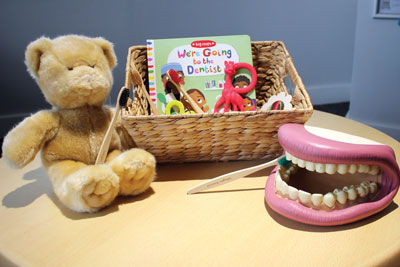
teeth are not for biting• Reading storybooks, for example the behaviour series by Elizabeth Verdick and other authors, such as ‘Teeth are not for Biting’, is commonly used in Early Years settings to help reinforce positive messages about behaviour. These could also be used by parents at home. This is most beneficial if used proactively, rather than as a reaction to specific events.


• Modelling turn-taking activities and extending play to other popular toys and interests so the child is engaged in another activity while waiting for the toy they want. Having more than one of a particularly popular toy or activity available can help smooth out any potentially tricky situations. Using a sand timer as a visual aid to help children to understand when it’s their turn can also help teach them to learn to wait.

For repeated incidences of biting, nursery staff monitor the ‘Why, Where, When’ of occurrences, to see if there is a pattern for this. For instance, is it when they are tired or hungry, or is there an activity that regularly triggers the impulse to bite? It may in fact be a combination of factors and strategies can then be put in place to help avoid situations that can give rise to biting.

For the parents of a child who bites, it is important to know that they are not alone. Very many children, some say up to a quarter of all children, will bite at some point during their early lives. Most commonly this is amongst those aged two to three years. That doesn’t make it any less difficult for all concerned but it is helpful to know that it is a phase that usually will pass.

The Lancing College family includes its two Prep Schools located in Hove and Worthing and Little Lancing Day Nursery & Forest School which offers day care all-year round for children aged two months and over. www.littlelancing.co.uk, www.lancingcollege.co.uk

doula and baby

Doulas – what are they and what benefits do they bring?

By baby health, Childcare and Nannying, Early Years, family
by Jo Slade
Birth and postnatal doula

Imagine being able to look forward to your birth without fear. Or enter motherhood and family life feeling calm and supported. This is exactly what a doula can help you with! In a time where it is so important to seek your own education around pregnancy, childbirth and postnatal care, a doula can be beside you every step of the way.

A birth doula
A birth doula is a non-medical professional, trained to provide support to women and families throughout pregnancy and birth. They will get to know you during your pregnancy, and can provide evidence-based information and antenatal education about what to expect from labour and birth, as well as being on-call to join you when you give birth – whether at home, in hospital or at a birth centre – to provide non-judgemental, practical, and emotional support.

They can be instead of, or in addition to, a birth partner. Someone who is there for you (both), who knows you and what’s important to you, and can give you the confidence to look forward to, plan, and advocate for the birth you want – whether you are aiming for a completely natural experience, a planned caesarean, or something in between!

Studies show that the continuity of care and support that doulas provide can lead to:
• Decreased likelihood of a caesarean or instrumental delivery.
• Increased likelihood of a shorter labour.
• Decrease in use of pain medication.
• Increased likelihood of feeling positive about your experience.
• Decreased likelihood of feeding issues.

A doula can be a great choice for first time mothers and parents – helping to settle nerves and talk about the unknown, but also for subsequent parents, who maybe didn’t have the best experience of birth or the postnatal period the first time around and want to feel more informed and supported going forward.

The average price of a birth doula ranges from £500 to £2000. This depends on your area, the different services offered and the level of experience of the doula.

A postnatal doula
A postnatal doula is professionally trained to provide support to women and families following the birth of their baby. The postnatal period should be a time to slow things down, take time to recover and enjoy your new baby, and although wonderful, it can sometimes feel overwhelming, as it’s all so new!

A doula will visit you at home, support you with adjustment to life with a new baby and give you the confidence to find your own way of mothering and parenting. They can help with:
• Breastfeeding and feeding.
• Holding your newborn so you can rest or have a bath.
• Hearing and chatting about your birth story.
• Light housework.
• Preparing nourishing meals.
• Entertaining older siblings.
• Walking the dog!

The importance of feeling supported and cared for in what is sometimes known as the fourth trimester should never be underestimated – it can have a substantial impact on your health and happiness going forward.

A postnatal doula usually charges by the hour, with a minimum number of hours booked. Hourly rates can range between £15 and £30.

There are birth and postnatal doulas, and many that provide both services. Most doulas offer an initial meeting, either in person or via Zoom, to see whether you are suited to each other, and they will expect you to be meeting with other doulas before you make your decision.

Some reputable online directories you can visit to find a trained doula in your area are:
• The Doula Directory
• Doula UK
• Find My Doula

Investing – time, energy and money – into one of the most important days of your life, and the months following, is a powerful acknowledgement that you are worthy of support.

However, if cost is a prohibitive factor, there may be some funds available. For example, the Doula UK access fund and Doulas Without Borders.

Jo Slade is a birth and postnatal doula. She lives in Brighton and provides doula support to families in many locations across East and West Sussex. For enquiries or to find out more, you can visit her website www.thedoulajoslade.co.uk email: jo@thedoulajoslade.co.uk or call her on 07779 457640