by Lucy Owen-Collins, Head of Adventures at Bee in the Woods
Summer has a way of inviting us outdoors. The days are longer, shoes are optional and suddenly the world feels full of possibility. For many parents, though, summer can also bring a familiar pressure: How do I keep the children entertained?
However, children don’t need endless organised activities or expensive days out to have a rich summer. Some of the most powerful learning and memorable times happen when children are trusted with real experiences – using tools, growing food, cooking outdoors, building things, exploring wild spaces and testing their own capabilities.
Outdoor play offers something many modern childhoods have less of: freedom to experiment, opportunities to take manageable risks and space to become genuinely capable and grow.
Here are five outdoor skills families can explore together this summer.
1. Learn to use real tools
Many adults instinctively think that real tools are too dangerous for young children, but with careful supervision and clear boundaries, children are often far more capable than we expect.
Start simple by supporting your child to:
• Hammer golf tees into a pumpkin, log or thick cardboard.
• Use a child-friendly hand drill to make holes in conkers or driftwood.
• Build a simple stick boat using string and found materials.
Children are naturally drawn to real, purposeful work. Using tools develops hand-eye coordination, concentration, perseverance and problem-solving – but perhaps most importantly, it helps children learn how to assess risk. Child sized hammers and hand drills can be sourced online and can be used safely with supervision.
Rather than teaching children to fear tools, we can teach respect, safe handling and responsibility.
Top tip: Resist the urge to fix it for them. A slightly wonky creation built independently is far more valuable than a perfect adult-made one.
2. Grow something they can eat
You do not need an allotment, greenhouse or even much space for this one. A few pots on a doorstep or balcony can become a summer classroom.
Easy child-friendly choices:
• Strawberries
• Salad leaves
• Peas
• Mint
• Nasturtiums
• Tomatoes.
There is something magical about watching a child check their plant every day, noticing tiny changes and taking responsibility for watering.
Gardening teaches patience, observation, cause and effect and care for living things. It’s also a wonderful way to encourage adventurous eating – children are much more likely to taste something they’ve grown themselves.
And who doesn’t love digging for worms!
3. Cook outdoors
Outdoor cooking creates a special kind of magic that makes for a memorable summer.
There’s something about preparing food in fresh air – collecting ingredients, stirring, waiting, tasting – that naturally draws children in. Give children of all ages real jobs – stirring, chopping softer foods (age appropriately), mixing, wrapping and serving.
If you have a fire pit, wonderful. If not, a barbecue, camping stove or picnic setup works beautifully.
Simple ideas:
• Elderflower, blackberry or blueberry pancakes (Vegan/gluten free recipes can be found online too).
• Banana boats (banana with chocolate melted inside foil).
• Campfire apples or pineapples with cinnamon.
• Flatbreads cooked outdoors.
• Herb butter corn on the cob.
Cooking supports maths (measuring, quantity), language development, sequencing, fine motor skills and independence. It also creates something less measurable and equally important: connection. Shared outdoor food experiences become the moments children remember.
4. Become a beach explorer
Living by the coast gives families a wonderful summer classroom.
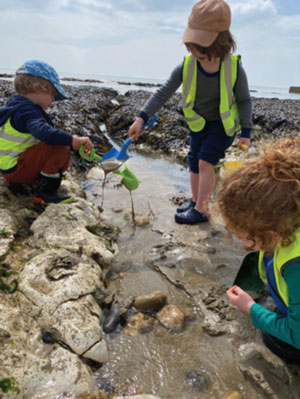
A trip to the beach doesn’t need to mean simply paddling and ice creams (although both are lovely). Children are natural scientists when given the chance.
Try:
• Shell sorting by shape, colour or size.
• Driftwood sculpture building.
• Rock pooling with gentle care for wildlife.
• Watching wave patterns.
• Drawing maps in the sand.
• Collecting seaweed varieties.
• Noticing tides and how the shoreline changes.
Beach exploration encourages observation, curiosity, early science thinking and environmental awareness.
For families living in coastal towns, the beach also offers an important opportunity to teach safety awareness and risk assessment – essential life skills for children growing up by the sea.
Notice the waves together.
Ask questions:
• Does the sea feel calm today?
• Would it feel safe to go to the water’s edge?
• What might the sea look like when it isn’t safe?
• What would we do if the waves were high?
• How deep is safe to go?
These kinds of conversations help children learn that risk is not something to fear, but something to notice, think about and respond to.
One child may spend an hour fascinated by a crab. Another may become deeply invested in transporting wet sand from one place to another. Both are learning. Alongside all the joy, digging, splashing and discovery, children are developing respect for the sea – understanding both its beauty and its power.
Top tip: Keep a spare towel, spare clothes and low expectations about staying clean!
5. Build a den
If I could prescribe one childhood activity, it might be den building.
Dens are extraordinary spaces because children must imagine them before they exist. You don’t need woodland to do this.
Try:
• Garden dens with sheets and chairs.
• Stick shelters in a local park.
• Beach windbreaks.
• Mini fairy shelters made from natural materials.
• Blanket forts that migrate outdoors.
Den building develops:
• Planning
• Engineering thinking
• Collaboration
• Persistence
• Creativity
It also gives children ownership of space – something many children deeply value. And once the den exists, the imaginative play begins!
Let children lead. The ‘best’ den is not the neatest one.
Family life can be wonderfully full, especially in summer, with so many opportunities, outings and activities on offer.
Yet some of childhood’s richest experiences often come from simpler moments – getting muddy, hours of playing, solving problems, building, climbing, cooking, digging and discovering.
The outdoors offers a rare kind of freedom: space to explore, test ideas and grow in confidence. Sometimes the most memorable summer moments are the ones where children are given time, trust and a little room to surprise us.
Bee in the Woods Kindergarten is a woodland preschool and community Forest School for three to seven year olds, based in Portslade and Stanmer Park in Brighton.
For more information www.beeinthewoods.co.uk