
by Sarah Griffiths, Head of Prep Brighton Girls
Spend a day in a typical primary classroom and you’ll quickly notice something teachers have been quietly navigating for years: boys and girls don’t always learn at the same pace, or in the same way, especially in those early school years. That’s why the idea that girls often study better without boys at primary level isn’t as controversial as it might first sound. In fact, it’s less about exclusion and more about creating the right conditions for learning at a very specific stage of development.
Let’s start with maturity, because it’s hard to ignore. Anyone who has worked with young children knows that girls, on average, tend to settle into routines earlier. They’re often more comfortable sitting still, listening carefully and completing tasks without constant redirection. Boys, meanwhile, are frequently still bursting with energy, testing boundaries and figuring out how to channel all that movement into something productive. There’s nothing wrong with that, it’s part of growing up, but it does mean teachers in mixed classrooms often have to divide their attention.
And that division of attention matters. If a teacher is spending a chunk of the lesson managing interruptions or helping one group stay on task, the other group, often the girls, may not be pushed as far as they could be. In a girls-only classroom, that imbalance largely disappears. The pace can pick up, the focus sharpens and there’s more room for deeper learning.
Then there’s the question of classroom atmosphere. Many girls at primary age seem to thrive in environments that are calm, structured and collaborative. They tend to enjoy discussion, group work and steady progress through tasks. Drop that preference into a room that’s a bit noisier or more unpredictable, something that can happen when you mix in a lot of high-energy behavior, and concentration can start to slip. It’s not that girls can’t cope; it’s that they often do better and are happier when they don’t have to.
Confidence is another big piece of the puzzle. In mixed classrooms, boys can sometimes dominate the space through calling out answers, taking up more speaking time, or simply being more visibly assertive. Again, this isn’t universally true, but it happens often enough to shape classroom dynamics. Some girls respond by stepping back, hesitating, second-guessing and participating less.
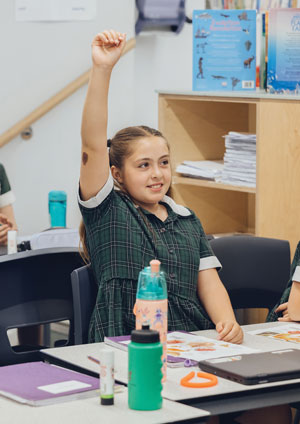
Take boys out of the equation, though, and something interesting happens. Girls who might have stayed quiet start putting their hands up. They test ideas and take risks. Without that subtle sense of competition or comparison, the classroom can feel like a safer place to speak up and that confidence feeds directly into better learning.
Social dynamics play their part too, perhaps more than we like to admit. At primary age, children are already very aware of each other. Friendships, impressions and even early forms of self-consciousness can creep in. In mixed settings, that can sometimes turn into distraction through whispering, showing off, or simply paying more attention to who’s watching than to what’s being taught. Remove that layer, and the focus often shifts back where it belongs: the learning.
A study in Australia found that girls’ confidence tends to fall below boys from around age nine, and persists into old age. But girls at single sex schools buck this trend: no difference in self-confidence was found between boys and girls who had been educated in single-sex contexts. (Fitzsimmons et al, 2018)
There’s also a strong case to be made about stereotypes, even among very young children. By the time they reach primary school, many have already absorbed ideas about what boys and girls are ‘supposed’ to be good at. Maths is more for boys and reading is for girls. These messages don’t need to be spoken out loud, sadly they’re picked up from the media, older siblings and society in general.
In a girls-only classroom, those assumptions start to lose their grip. Girls are more likely to take the lead in every subject, not just the ones traditionally associated with them. They’re more willing to tackle challenges in maths or science without looking over their shoulder. And over time, that can make a real difference in both achievement and attitude. Professor Sarah Smith OBE, Head of Economics, University of Bristol stated: “If girls were studying subjects such as STEM and economics at the same rate as boys, you could halve the gender pay gap at the point at which they graduate.”
From a teaching perspective, single-sex classrooms can also make life a bit simpler. When the group you’re teaching shares similar developmental patterns, it’s easier to tailor lessons that get the best of your cohort. You can lean into discussion-based learning, collaborative projects and reflective thinking without constantly adjusting for completely different energy levels or behavioural needs. This results in more teaching time and less fire fighting.
Of course, none of this is to say that mixed classrooms don’t work. They do, and for many children, they work very well. Learning to interact with the opposite sex is an important part of growing up and co-education has clear social benefits. But when we zoom in on the primary years, those formative, uneven, slightly chaotic early stages of development, it becomes easier to see why some argue that girls are given a better academic platform when boys aren’t in the room.
It’s not about one group being better than the other. It’s about timing. At this particular age, girls and boys are often on slightly different developmental tracks and that gap can shape how effectively they learn together. For girls, a single-sex environment can mean fewer distractions, more confidence and a classroom experience that feels better suited to how they naturally engage with learning. And really, that’s the heart of the argument: when the environment fits the learner, the learner thrives.
Brighton Girls is family of big and little sisters and the only all-through girls’ school in Brighton. Every student is encouraged to grow into an individual who is kind
in character, bold in ambition and resilient in the face of challenge. www.brightongirls.gdst.net