
by Giulia Galli
Parental Coach
How our words and our tone become their inner voice
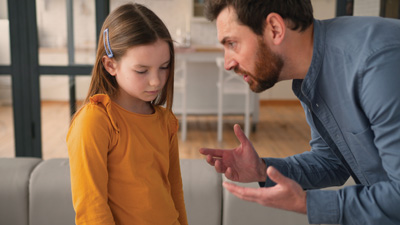
Lately, I’ve been noticing a sound that cuts through everyday life – not laughter from the playground or the hum of conversation drifting from kitchens, but shouting. Not the occasional raised voice that slips out in frustration, but the repeated, sharp, heavy kind.
Sometimes it’s siblings snapping at each other. Sometimes it’s teenagers slamming back at parents. And often, it’s parents themselves, shouting at toddlers, at primary-age children, even at babies not yet walking.
One mother’s voice has stayed with me. Every time her one-year-old knocks something over or spills his food, her response is the same: loud, harsh, full of judgement. Every fall of a toy, every food-splattered shirt, every curious gesture that leaves a mark is met with anger. He’s only one. Just one.
And yet, what he is learning isn’t just how objects fall or how sounds are made: it’s what power feels like. What anger sounds like. What happens when you do something ‘wrong’. What it means to be small in a world where big voices rule.
Let’s be clear – this isn’t about shaming parents. We’ve all raised our voices. I have, too. Shouting happens. Sometimes we’re exhausted, sometimes we’re overstimulated, sometimes we’re carrying far more than our nervous system can handle. And many of us grew up with shouting ourselves, so it became the norm.
But here’s the truth – shouting doesn’t teach reflection. It teaches fear. It doesn’t create understanding. It creates compliance. And in children, especially very young ones, it doesn’t build confidence. It builds shame.
Think about it – when a toddler spills water, shouting doesn’t teach them how to hold the cup better next time. It teaches them that trying is dangerous. When a child touches something fragile, a loud scolding doesn’t teach caution, it teaches that curiosity isn’t safe. When a child is overwhelmed and cries, shouting doesn’t teach them how to regulate their feelings, it teaches them that big emotions aren’t allowed.
This is the danger of repeated shouting: it turns moments of behaviour into a story about identity.
“I dropped something” becomes “I’m clumsy.” “I was curious” becomes “I’m annoying.” “I was upset” becomes “I’m too much.”
Those stories stick. And they echo long after the moment has passed.
The irony is that shouting might get us what we want in the moment – it might stop the behaviour. But the cost is disconnection. We silence. We scare. We disconnect. And in that silence, children don’t learn what to do differently. They just learn to feel small.
So what’s the alternative? First, awareness. Notice when the urge to shout rises. Often, it’s not the behaviour itself that pushes us over the edge, but the meaning we attach to it: “He’s doing this on purpose.” “She never listens.” “I can’t take this anymore.” That story is what fuels the reaction.
Second, pause. Parenting gives us endless opportunities to reset. Even a few seconds can change everything. Lower your voice instead of raising it. Name your own feeling: “I’m getting frustrated.” Ask for help: “Let’s take a minute to calm down.” Step out of the room for three breaths before you respond. Replace “What’s wrong with you?” with “Let’s try again.”
Small shifts like these model something powerful. They show children that mistakes are part of learning. That emotions can be managed without force. That connection matters more than control.
Because children aren’t just learning from our instructions. They’re absorbing our example. The words and the tone we use today becomes the inner voice they’ll carry tomorrow.
Think back to your own childhood. The voices you heard most often probably still echo in your head. They may tell you to “be careful,” to “try harder,” or perhaps to “quiet down.” Those phrases, spoken in particular tones, become part of who we are. And now, as parents, we are shaping that voice for our children.
That’s why shouting is more than just noise. It’s a message. And if repeated, it becomes a belief.
This isn’t about never shouting again. None of us are perfect. It’s about noticing, repairing and choosing differently when we can. Even after we’ve raised our voice, we can come back and say, “I shouldn’t have shouted. I was tired and frustrated. Let’s try again.” That moment of repair doesn’t erase what happened, but it teaches accountability. It shows children that mistakes can be mended.
One day, our children will be grown. They may not remember every word we said. But they will remember how it felt to be with us. Was the home a place where mistakes were punished or explored? Where curiosity was stifled or encouraged? Where fear entered the room with us or safety did?
When the volume goes up, connection goes down. But when we choose calm, patience and presence instead, we give our children something far more lasting than obedience: we give them an inner voice that supports them for life.
Giulia Galli is a parental coach and author of When a Parent is Born. She supports families with intentional parenting. For further information please visit www.reegal.co.uk