by Lucy Owen-Collins
Head of Adventures at Bee in the Woods Kindergartens
What outdoor nurseries know about risk, freedom and play
Spring has a wonderful way of reminding us that children, like the natural world, grow best when given space, time and the right conditions. As blossoms return and days stretch out, many families find themselves venturing outside more often – opening the door to something Early Years educators have known for decades: outdoor play isn’t just ‘nice to have’ – it’s one of the most powerful ways to build resilience in young children.
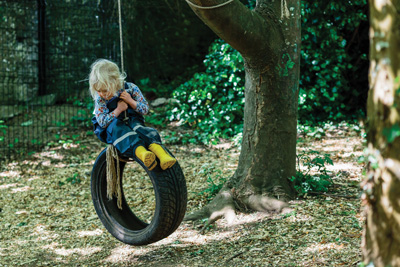
At outdoor nurseries, children spend their days immersed in nature. What we observe, time and again, is that resilience isn’t taught – it’s lived. Through climbing, balancing, running and problem-solving, children learn what their bodies can do and how to navigate the world with confidence.
“Resilience isn’t taught – it’s lived, through movement, challenge and freedom.”
Why risky play matters
Risky play – clambering, balancing, running on uneven ground, navigating logs, slopes and tree roots – has been widely shown to increase children’s coordination, confidence and risk-management skills. Importantly, these experiences don’t remove danger; they teach children what danger feels like and how to make good decisions around it. It means offering children opportunities to assess, manage and respond to challenges in a supported environment.
When a child pauses at the base of a muddy slope or tests a branch before climbing, they’re developing judgement, balance and self-awareness. Outdoor practitioners support these moments with calm presence rather than intervention, asking questions like, “What’s your plan?” or “How does that feel?”
Research consistently shows that children who engage in appropriately risky play develop stronger motor skills, better risk assessment and greater emotional regulation. Just as importantly, they learn confidence in their own decision-making.
“When children learn to judge risk, they grow confidence – not fear.”
Health resilience, built outside
Spring weather can be unpredictable, but outdoor learning thrives on this variety.
Children who spend long periods outside become more adaptable – less phased by drizzle, cold breezes or muddy boots.
Research suggests that regular outdoor play supports immune health in several ways. Exposure to fresh air, sunlight and diverse natural environments helps regulate circadian rhythms and supports vitamin D production- linked to immune function and overall wellbeing. Studies also highlight the role of environmental biodiversity; contact with soil, plants and natural microbes can help strengthen the immune system by supporting healthy gut and skin microbiomes.
In practical terms, this often looks like children who cope better with seasonal changes, recover more quickly from minor illnesses and show improved energy and stamina.
“Muddy hands aren’t a problem – they’re part of building a healthy immune system.”
Nature: The ultimate motor-skills playground
Nature provides a constantly changing environment that challenges the whole body. Uneven ground strengthens balance and coordination. Climbing builds core and upper-body strength. Carrying heavy objects develops proprioception and teamwork.
These physical experiences are deeply connected to brain development. Neuroscience tells us that movement supports learning, attention and emotional regulation. When children navigate varied terrain, they create richer neural pathways – laying foundations for skills like writing, concentration and problem-solving.
“Uneven ground builds strong bodies – and adaptable minds.”
Trust, courage and self-assurance
Perhaps the most powerful element of outdoor learning is trust. Children are trusted to try, to wobble, to fall safely and to try again. Adults remain close, attentive and supportive, but not intrusive.
A child jumping from a stump isn’t just playing – they’re testing belief in themselves. When adults honour that moment, children internalise a powerful message: I am capable.
Over time, this self-assurance travels with them – into friendships, learning and everyday challenges beyond the woods.
“Confidence grows in the space between challenge and trust.”
Advice for families: Bringing risk, freedom and play into family life
You don’t need a woodland to experience the benefits of outdoor play. Spring is a wonderful time to lean into simple, low-prep ideas that help children stretch their bodies and minds.
1. Make micro-adventures part of your week
A walk to the local park can become a balancing challenge on curbs, logs or small walls. Invite children to choose the ‘wobbly path’.
2. Let them get properly muddy
Messy play is body work, brain work and emotional work. Pack spare clothes in the car and relax into it.
3. Ask reflective questions instead of instructions
Try: “What’s your plan?” “How does that feel?” “Do you need anything to make this safer?” These questions build decision-making skills.
4. Resist the urge to rescue too quickly
If a child is struggling to climb, pause before stepping in. Check they are safe, then give them space to problem-solve.
5. Vary the terrain
Choose parks, beaches, woodlands or even gardens with natural gradients, slopes and textures. Nature is built for motor-skill development.
6. Celebrate courage, not outcomes
Praise the trying, not the height climbed. Children flourish when bravery is noticed.
Growing resilience, one spring day at a time
As children run, climb and explore through spring, they are doing far more than playing. They are building physical strength, immune resilience and emotional confidence through experiences that can’t be replicated indoors.
Outdoor nurseries remind us that childhood doesn’t need to be smoothed or rushed. When children are given freedom, trust and space to move, they grow into themselves – strong, capable and ready for what comes next.
Sometimes, the most powerful thing we can do is just open the door and let nature lead the way.
Bee in the Woods Kindergarten is a woodland preschool and community Forest School for three to seven year olds, based in Portslade and Stanmer Park in Brighton.
For more information www.beeinthewoods.co.uk