by Deborah Mercer, Director of Alta Academy of Dance
When parents first consider dance classes for their child, they might picture ballet shoes, music, carefully pointed toes and perhaps the excitement of a first performance. But while learning to dance is certainly part of the experience, some of the greatest benefits go beyond the steps.
For young children in particular, dance offers a unique combination of physical movement, music, imagination, discipline and friendship.
In an increasingly busy and screen-filled world, a dance class provides something refreshingly different – a space where children can be active, creative, sociable and completely engaged in what they are doing. And, with the right teaching environment, the skills they develop can reach far beyond the studio.
Confidence that grows naturally
For a young child, simply walking into a dance class can be an achievement. They enter a room, perhaps without a parent beside them, meet a teacher and other children, and begin trying something new.
A nurturing dance environment allows that confidence to develop at the child’s own pace. There should be encouragement to participate and improve, but also an understanding that children develop differently. Some will throw themselves into a class immediately; others need a little more time. Confidence grows through small successes: remembering a sequence, mastering a new movement, volunteering to demonstrate or taking part in a first performance.
Children begin to understand that they can attempt something unfamiliar, practise it and improve. Confidence isn’t always about being the loudest child in the room – sometimes it is simply having the courage to join in.
Coordination and body awareness
Children are constantly learning how their bodies work, and dance provides an enjoyable way to develop their understanding. Ballet requires children to coordinate their limbs while moving in time to music. They are encouraged to develop good posture, balance, spatial awareness and control, building strong foundations for physical development.
For younger dancers, this shouldn’t mean endless technical exercises. The best early training combines sound technique with movement, imagination and enjoyment.
Children may be learning important physical skills without even realising it. Those foundations can complement everything from playground games to football, gymnastics and other sports.
Learning to concentrate
Watch a children’s dance class and there is far more going on than first meets the eye. A child might need to watch a demonstration, listen
to an instruction, remember several movements, recognise a musical cue and then put everything together. That requires concentration, memory and self-control.
A well-structured class encourages children to focus for gradually longer periods without making learning feel overly formal. They learn to listen when somebody else is speaking, follow instructions, wait for their turn and work as a team. These are simple skills, but valuable ones – both inside and outside the studio.
Discovering music through movement
Music is at the heart of dance. Rather than simply hearing it, children learn to respond physically to rhythm, tempo and mood. They begin to recognise when music is quick or slow, strong or gentle, playful or dramatic.
As children progress, that develops into musicality – understanding phrasing, timing and how movement relates to what they hear. But there is also something wonderfully instinctive about watching a young child hear a piece of music and simply want to move. Good dance teaching enables that instinct. Technique matters, but so does retaining the joy and creativity that made a child want to dance in the first place.
Patience, perseverance and progress
Dance also teaches children that improvement doesn’t always happen immediately. A movement that feels difficult one week may become easier several weeks later. Something that once required enormous concentration can eventually feel completely natural.
Children experience the connection between practice and improvement in a very tangible way. This helps develop patience and perseverance. Mistakes become a normal part of learning rather than something to fear, particularly when children are taught in an environment where effort and progress are celebrated alongside achievement.
There is an important life lesson here – you don’t have to be able to do something perfectly the first time to enjoy it or eventually become good at it.
Learning to be part of a group
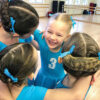
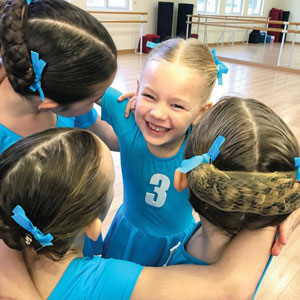
Although dance can appear to be an individual pursuit, dance is remarkably social. Children learn to share a studio, take turns, form lines, work with partners and move as part of a group. They become aware not only of what they are doing, but of the people around them.
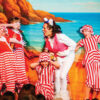
Preparing for a performance develops this further. Every child has a part to play and the group succeeds by working together.
For many children, dance also creates a valuable circle of friendships beyond school. As they progress through classes together, those friendships can become an important part of why they continue to enjoy dancing. Creating that sense of belonging is every bit as important as teaching the steps.
Imagination should have a place too
For the youngest dancers especially, ballet should still feel magical. Children might become butterflies, animals, fairytale characters or imaginary creatures. They might travel across the studio like falling snow, march to a rhythm or use movement to tell a story.
There is plenty of time for greater technical discipline as children develop. Early classes can introduce those foundations while still giving children permission to imagine. That balance between structure and creativity is one of dance’s great strengths. Children learn that there are rules and techniques to master, but also that movement can be expressive, personal and fun.
More than simply learning to dance
Not every child who walks into their first ballet class will become a dancer and that should never be the only measure of whether their time in the studio was worthwhile. The value can be found in everything happening around the steps – the shy child who gradually finds the confidence to perform, the four-year-old who learns to wait patiently for their turn, the pupil who discovers that practise makes something difficult achievable or the group of friends learning to move together to a piece of music.
The best children’s dance education is therefore about much more than producing technically accomplished dancers. It is about creating an encouraging environment in which children can develop physically, creatively and socially while discovering a genuine enjoyment of movement and music. The pliés, jumps and performances are part of the journey. Aside from the health benefits, the confidence, coordination, concentration, musicality, patience and friendships developed along the way may ultimately be the lessons that stay with them longest.
Deborah Mercer is the Director of Alta Academy of Dance. Classes for ages 3+ to adult, taught by qualified and experienced teachers in a choice of five venues across Brighton and Hove.
For more information, please visit www.altadance.co.uk